
















A cooking gas cylinder may be properly sealed and show no visible signs of damage, but the equipment connecting it to a stove could still put an entire household at risk.
That is the warning from Massy Gas Products (Guyana) Ltd. Chief Executive Officer Augustus Harris, who says the use of outdated or non-recommended LPG regulators remains a major concern as more Guyanese households depend on cooking gas.
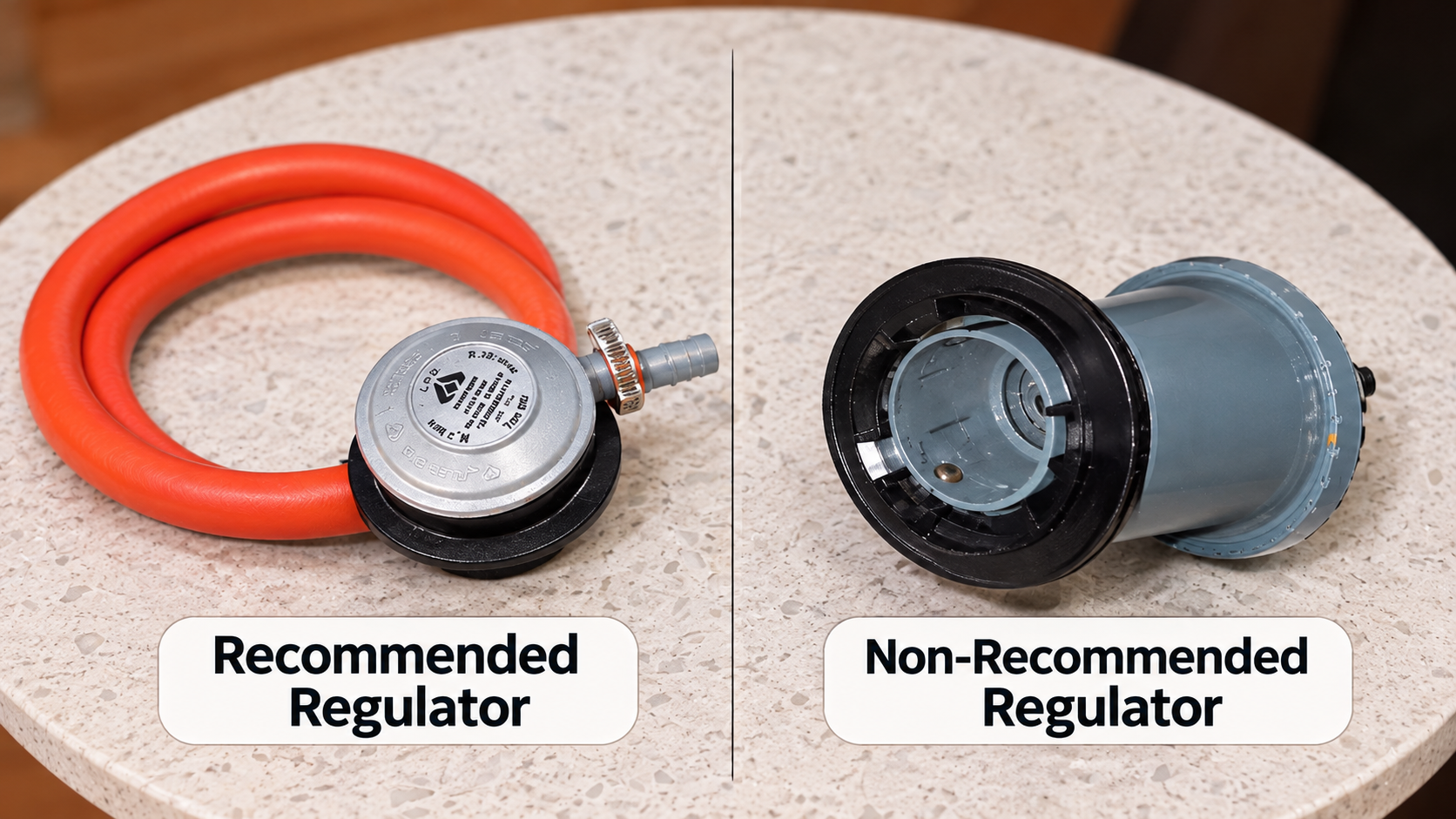
Harris raised the issue last week during a breakfast meeting with members of the media, where the company demonstrated the differences between a regulator it recommends and another design it considers unsuitable for use with its cylinders.
He said investigations into reported incidents have repeatedly drawn attention to faulty regulators and other accessories, rather than necessarily pointing to defects in the cylinders themselves.
According to Harris, one of the concerns is that some regulators can continue releasing gas even when switched off, creating a potentially dangerous situation for households that may believe their cooking gas supply has been secured.
The company demonstrated how the non-recommended model can fail to prevent gas from escaping even when its control is in the off position.
The recommended regulator, meanwhile, has a different design and safety features intended to address those concerns.
Harris said Massy has been working to make the recommended equipment more accessible to consumers, including through a programme that offered regulators free of charge.
The company initially targeted the distribution of 1,000 regulators but managed to distribute only slightly more than 800.
He acknowledged that affordability has been one of the reasons some consumers continue purchasing cheaper alternatives, even when those products may not meet the recommended specifications.
The issue is particularly important because LPG is used daily in homes across Guyana, often with cylinders, stoves, hoses and regulators purchased from different suppliers.
Harris said the market has changed considerably over the years. Previously, gas suppliers exercised greater control over the equipment used by customers, including the installation of stoves and the accessories connecting them to cylinders.
Today, consumers can purchase a cylinder from one supplier, a stove from another retailer and a regulator from a separate vendor.
This creates an environment in which the different components may not necessarily be compatible or meet the required safety specifications.
The company's concerns come against the background of several serious cooking-gas incidents in Guyana.
In September 2025, a flash explosion at a home in C Field, Sophia, injured a woman and her teenage son. Massy subsequently said its inspection found that the cylinder had no evidence of leakage and its rubber seal was intact, but that a faulty, non-recommended regulator had released gas even while switched off.
The woman, Harriet Ray, later died from injuries sustained in the incident, while her son was discharged from hospital.
The company's findings in that case were its own preliminary assessment, rather than a finding that every reported gas-related incident in Guyana has the same cause.
Recognising the wider safety concerns, the Government has since moved to strengthen the standards governing LPG cylinders and regulators.
In October 2026, Order No. 189 of 2026 declared the revised national standards for LPG cylinders and low-pressure regulators compulsory, with enforcement scheduled to begin on April 1, 2027.
The two standards are GYS 264, which covers LPG cylinders and their storage, handling and transportation, and GYS 523, which covers low-pressure regulators.
The Guyana Energy Agency will monitor compliance with the cylinder standard, while the Guyana National Bureau of Standards will oversee the regulator standard.
The requirements are intended to ensure that cylinders and regulators entering and being sold in Guyana meet established safety and performance specifications.
For consumers, however, safety also depends on how the equipment is installed, maintained and used.
The Guyana Energy Agency advises households to use only regulators, hoses and clamps recommended by their gas supplier. Cylinders should be stored upright in dry, well-ventilated areas, away from heat sources and combustible materials.
Consumers should also regularly inspect hoses and regulators for cracks or other damage. The agency recommends replacing hoses every two to five years and regulators every five years, depending on their condition and wear.
The GEA also advises consumers to check cylinders for visible damage, including dents, corrosion, cuts and bulging, and to ensure the cylinder's seal is intact when purchasing or receiving a refill.
If a household suspects a gas leak, the advice is not to light the stove or operate electrical equipment. If it is safe to do so, turn off the stove and regulator, open doors and windows to ventilate the area, and contact the Guyana Fire Service and the gas supplier for assistance.
The Guyana Fire Service can be reached at 912.
Massy says it will continue working with the relevant agencies to improve public awareness and encourage the use of recommended equipment.
With mandatory national standards due to be enforced next year, the issue now extends beyond individual household choices to the responsibility of manufacturers, importers, suppliers and regulators to ensure that unsafe equipment does not reach consumers.