















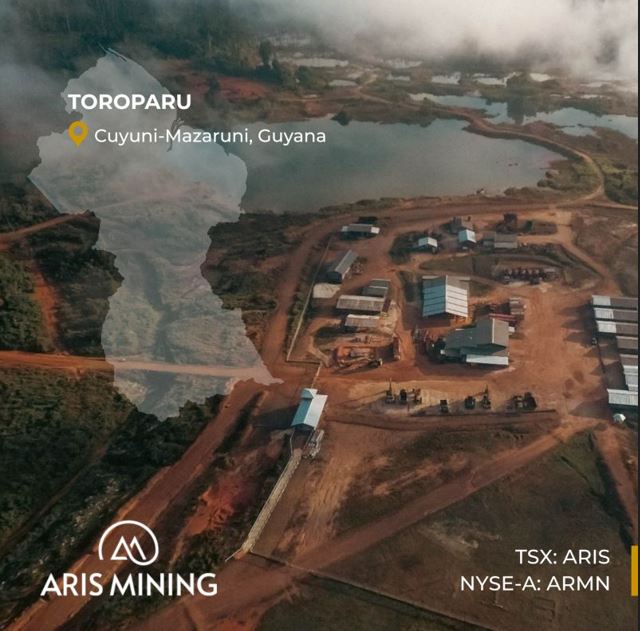
Guyana could collect more than US$4.6 billion in taxes and royalties over the life of the proposed Toroparu gold mine, according to a new study by Canadian mining company Aris Mining, which is advancing plans for what could become one of the country's major gold-producing operations.
The company's prefeasibility study, released on November 12, outlines a project expected to produce approximately 5.6 million ounces of gold over a 29-year processing period, including 21 years of mining.
Based on its financial projections, Aris estimates that Toroparu could generate approximately US$3.03 billion in corporate income taxes and US$1.61 billion in royalties for Guyana over the project's life.
Those projections are based on an assumed gold price of US$3,600 per ounce and remain dependent on the project securing the necessary approvals, financing and moving into commercial production.
The study estimates an initial funding requirement of approximately US$1.005 billion, while construction capital, including contingency, is estimated at US$1.119 billion.
At the assumed gold price of US$3,600 per ounce, the project has an estimated after-tax net present value of US$2.83 billion and an internal rate of return of 31.5 per cent.
The study also estimates that the operation could produce an average of 258,000 ounces of gold annually during its first 17 years of main-pit operations, before production declines during the later stages of processing.
Thousands of jobs projected
Beyond the potential revenue for Government, the proposed development could create substantial employment opportunities, particularly during the construction phase.
Aris estimates that construction could require a peak workforce of 1,529 people, while operations could employ up to 1,260 people.
The company currently employs 114 people on the project, including 106 Guyanese and eight expatriates. Of those employees, 77 are based at the project camp, while others are stationed in Georgetown, Itaballi and at the Puruni pontoon operation.
Aris says it intends to recruit a high proportion of its future workforce from within Guyana, although the study does not establish a specific local employment target for the construction or operational phases.
The scale of the proposed workforce could also create opportunities for Guyanese businesses supplying equipment, transportation, accommodation, food, maintenance and other services required to support a large mining operation.
However, the extent to which those opportunities translate into contracts for local companies will depend on the company's procurement arrangements, the technical capacity of local suppliers and the requirements attached to the project.
Environmental questions remain
While the financial and employment projections are significant, the company's technical report also identifies environmental issues that will require further attention as the project advances.
In particular, Aris' water-quality modelling identifies sulphate and arsenic as the main constituents of concern around the proposed tailings management and water-discharge systems.
The company says its modelling indicates that additional measures would be needed to manage sulphate levels, including an estimated 80 per cent reduction in dissolved sulphate loads during certain processing periods.
It is considering treatment measures and has included provision for a modular water-treatment system in its project cost estimates.
The report also states that further testing is required to confirm how the proposed sulphate reduction measures will be achieved.
Although the company's modelling indicates that arsenic discharges would remain below the applicable International Finance Corporation effluent limit, it acknowledges that additional treatment could be necessary if monitoring demonstrates that it is required.
The technical report further recommends additional work to verify environmental modelling and assess the effectiveness of proposed mitigation measures.
These issues will be important as regulators assess the updated project design, particularly given the potential implications for surrounding waterways and aquatic ecosystems.
Construction decision still subject to approvals
Despite completing the prefeasibility study, Toroparu has not yet received all the approvals required to proceed with construction.
Aris submitted an application for a large-scale mining licence to the Guyana Geology and Mines Commission in August 2026, and the application remains under review.
The company says the project has held environmental approval since 2012, with subsequent amendments and updates, but the revised development will require the applicable environmental management arrangements and any additional approvals to be secured before construction.
Its technical report states that an updated Environmental Management Plan framework has been submitted for approval.
Aris is targeting a construction decision in early 2027, subject to receiving the large-scale mining licence and other necessary approvals.
The company has also identified opportunities to extend the mine's operating life if further exploration establishes additional economically viable mineral resources.