


















By Kurt Campbell in Rio de Janeiro, Brazil
Guyana has quietly become one of the most influential players in global aviation's push toward net-zero emissions, supplying nearly two-thirds of all carbon credits currently approved for use by international airlines under the United Nations-backed CORSIA programme.
The revelation came during an International Air Transport Association (IATA) sustainability briefing in Rio de Janeiro on Saturday, where senior executives praised Guyana's environmental stewardship and described its carbon credit framework as a model other countries should follow.
Presented by IATA ahead of its 82nd Annual General Meeting, a slide shown by IATA Senior Vice President for Sustainability and Chief Economist Marie Owens Thomsen revealed that Guyana accounts for over 60 per cent of all CORSIA Eligible Emissions Units (EEUs) currently authorized for use by airlines.
The presentation showed that ten countries have supplied CORSIA-approved credits as of June 2026, with Guyana contributing 24.96 million credits through its ART TREES programme. That figure dwarfs contributions from all other participating countries and represents approximately 66% of the global total of38.03 million approved credits.
Countries listed alongside Guyana included Cambodia, Laos, Madagascar,Rwanda, Malawi, Tanzania, Gambia, Sierra Leone and Uzbekistan.
.jpeg)
The significance of Guyana's contribution is heightened by the aviation industry's ongoing struggle to secure sufficient supplies of Sustainable Aviation Fuel (SAF), widely regarded as the sector's most important long-term decarbonisation tool.
During the same briefing, IATA revealed that global SAF production is expected to reach just 2.4 million tonnes in 2026, accounting for only 0.8 percent of total aviation fuel consumption worldwide. Airlines are expected to spend approximately US$4.3 billion on SAF this year, yet production remains well below levels needed to place the industry on track for its net-zero emissions target by 2050.
Against that backdrop, carbon credits approved under CORSIA are expected to play a critical role in helping airlines meet their climate obligations while renewable fuel production scales up.
.jpeg)
Speaking after the briefing to Fueled's Kurt Campbell, Thomsen praised Guyana's approach to carbon market governance and environmental stewardship.
Responding to questions about Guyana's role, she described the country's credits as among the most respected within the CORSIA framework and highlighted the government's efforts to create a dedicated stream of credits specifically for aviation use.
According to Thomsen, Guyana successfully separated credits intended for airlines from those destined for other markets, helping to ensure transparency and environmental integrity.
She noted that Guyana had been strict in ensuring that credits entering the market are genuinely earned and properly accounted for, adding that "a lot of other countries can learn from Guyana."
The IATA executive also commended Guyana's broader leadership in forest conservation and climate stewardship, pointing to the country as an example of how developing nations can participate credibly in global carbon markets but said its not just for small economies ith Canada soon to come on baord.
Her comments came as IATA repeatedly stressed the importance of credible carbon markets during the transition to cleaner fuels. While SAF remains the aviation industry's preferred long-term solution, officials acknowledged that production volumes remain far below what is required to meet future climate targets.
IATA Director General Willie Walsh described the outlook as "another disappointing year" for SAF production, warning that the industry's pathway to achieving net-zero emissions by 2050 is becoming increasingly difficult.
"It looks to be another disappointing year for SAF production. Five years after committing to achieve net zero by 2050, SAF production will only account for 0.8% of airline fuel use this year," Walsh said.
The briefing also referenced Guyana's strong government backing for the initiative. During the presentation, IATA displayed correspondence from Guyana's Office of the President as part of its discussion on CORSIA credit supply, underscoring the country's active engagement with the international aviation decarbonisation effort.
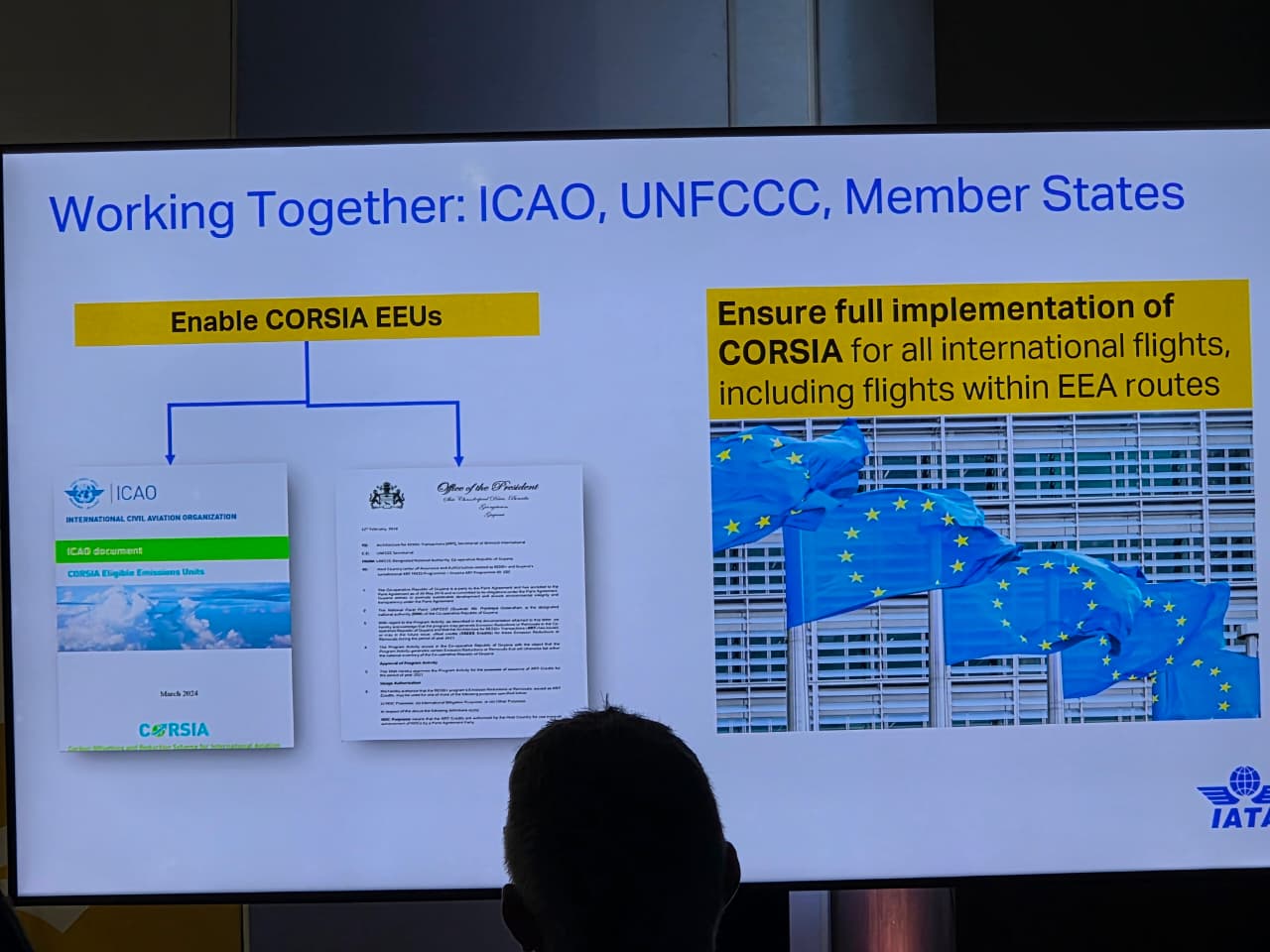
Guyana became one of the first countries globally to issue a Letter of Authorization allowing ART TREES carbon credits to be used under CORSIA, the Carbon Offsetting and Reduction Scheme for International Aviation established by the International Civil Aviation Organization.
For airlines, Guyana's credits offer something increasingly valuable: acredible, readily available source of emissions reductions in a market wherealternative decarbonisation options remain scarce.
That reality helps explain why Guyana's ART TREES credits have attracted significant attention from the global aviation industry. While many countries continue exploring how to participate in carbon markets, Guyana has already established itself as the dominant supplier of CORSIA-approved credits, giving airlines access to one of the largest pools of authorised offsets currently available anywhere in the world.
The figures presented in Rio come as airlines face mounting pressure from governments, investors and passengers to reduce their environmental footprint. IATA's latest passenger survey found that 89 per cent of travellers believe the aviation industry should continue reducing emissions even if governments scale back climate initiatives, while two-thirds said they would be willing to pay more to compensate for emissions.
With nearly 25 million approved credits already available and growing international recognition for its approach, Guyana has positioned itself at the centre of one of aviation's most important climate mechanisms.
The South American country, whose forests cover more than 85 per cent of its land area, has long argued that standing forests can generate economic value while remaining protected. Increasingly, the global aviation industry appears to be taking notice.



.png)



.png)