

















After watching Paimîye, a new documentary by Guyanese filmmaker Tara Leuvina Smith, I was reminded of how much we still gah learn about one of our most iconic natural symbols. This giant water lily appears on our coat of arms and holds the distinction of being our national flower.
For many Guyanese, the image is instantly recognisable. Yet there are still several misconceptions about the plant, from its correct scientific name to where it can be found in the country.
So leh we talk this ting and learn some tings:
- It is Victoria Amazonica, not Victoria Regia!
One of the most common errors in referring to Guyana’s national flower is calling it Victoria Regia.
While Victoria Regia was once widely used in older scientific literature, the accepted botanical name today is Victoria Amazonica. The change reflects updates in plant classification over time, not a change to the plant itself. In scientific terms, Victoria Regia is now considered a synonym rather than the correct name.
Despite this, the older name continues to circulate in conversations and in our education system, contributing to ongoing confusion about the plant’s identity.
- Many Guyanese have never seen the plant.
Although it is our national flower, many Guyanese have never seen a Victoria Amazonica growing in person.
Historically, the giant water lily could have been found at the back of the Botanical Gardens in Georgetown. Today, sightings along the coast are limited. The plants at the back of the Botanical Gardens have been replaced with the lotus. Small populations of the Victoria Amazonica can be found in select areas such as the pond at the University of Guyana, Turkeyen Campus, and in a small section at the front of the Botanical Gardens. These spaces remain some of the few accessible locations where people can observe the plant without travelling into more remote wetland and river environments like Karanambu Lodge.
One well-known site for the plant was at LBI, East Coast Demerara. However, at the end of the film we saw that those plants were removed for current road expansion and infrastructure development.
- It is not a Lotus!
Another common misconception is that the Victoria Amazonica and the lotus are the same plant.
While both are aquatic and produce visually striking flowers, they are completely different species with distinct structures and growing habits.
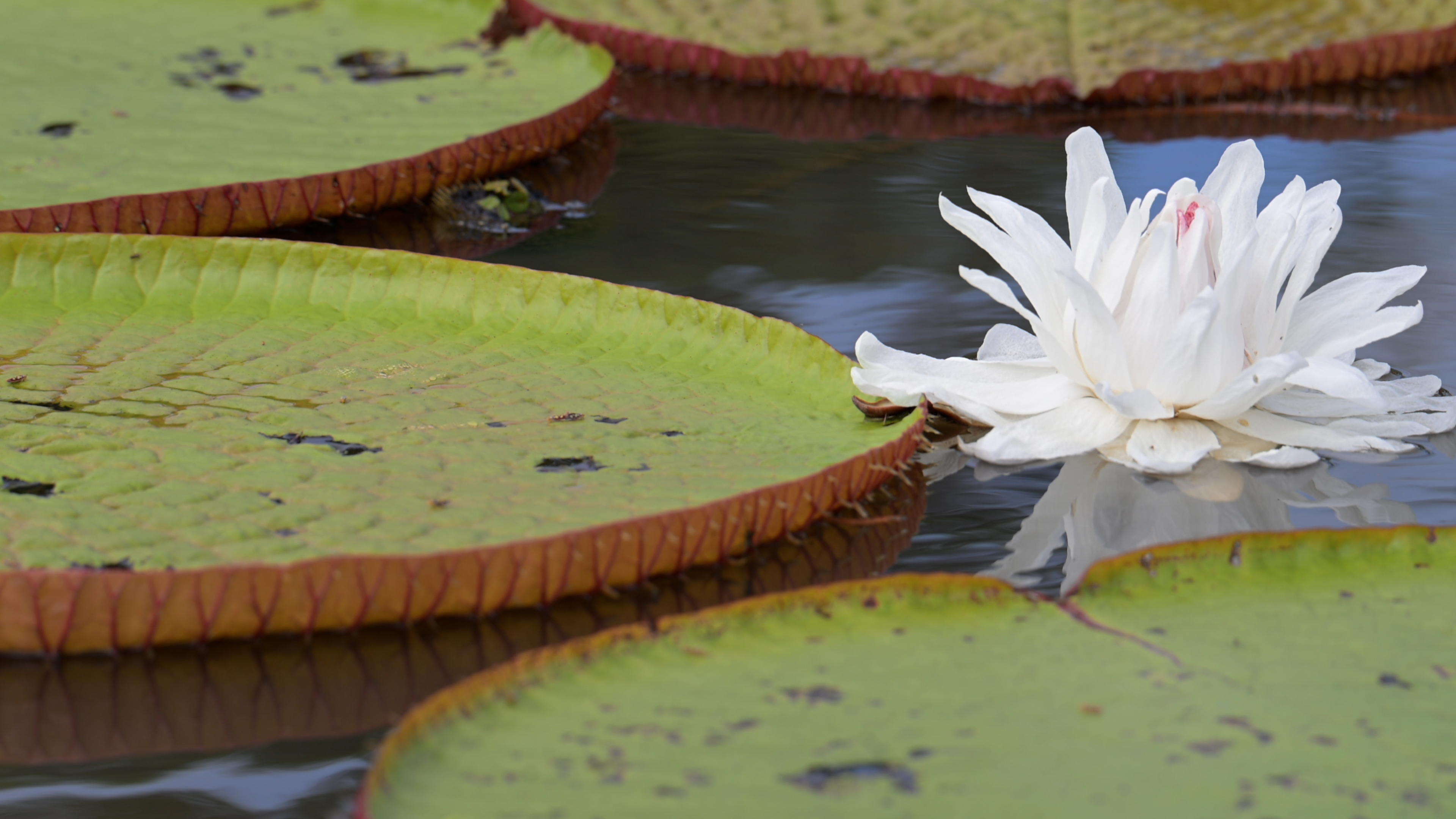
Victoria Amazonica produces enormous circular leaves that float flat on the water’s surface, often reaching over two metres in diameter. These leaves have raised rims that help support their structure and buoyancy. The lotus, by contrast, typically has leaves that rise above the water on long stems rather than floating flat.
Their flowers also differ significantly. Victoria Amazonica blooms are large and dramatic, and its healthy flowers are white, changing to pink before dying. Lotus flowers do not undergo this colour transformation and have a different overall structure and growth pattern.
These differences matter, especially in a country where both plants are often casually grouped together despite belonging to different categories.
- The Victoria Amazonica sustains life!
Beyond its cultural and national symbolism, Victoria Amazonica plays an important ecological role in freshwater environments.
Its leaves help regulate light penetration and create sheltered habitats for animals. Beneath the surface, the plant contributes to oxygen exchange within the water, supporting fish and other aquatic life.
This makes it an important part of maintaining healthy ecosystems, particularly in our rivers and ponds.
Why Should Guyanese Care?
In a country experiencing rapid development and transformation, it is easy to focus on what is being built, and overlook what has always been here. Victoria Amazonica is a living part of Guyana’s natural heritage that sustains biodiversity across the country and supports life in ways that are often unseen.
For many Guyanese, the giant water lily exists in photographs, textbooks, and the national Coat of Arms. Few have had the opportunity to see it bloom or understand its ecological importance. This matters because people are more likely to protect what they know and understand.
As Guyana continues to develop, we must preserve the natural world that defines us. Learning about our national flower is, ultimately, learning about Guyana. And that is something every Guyanese should care about.



.png)