















Guyana’s oil industry has a life cycle and the country is still near the beginning.
The first commercial oil from the Stabroek Block flowed in December 2019.
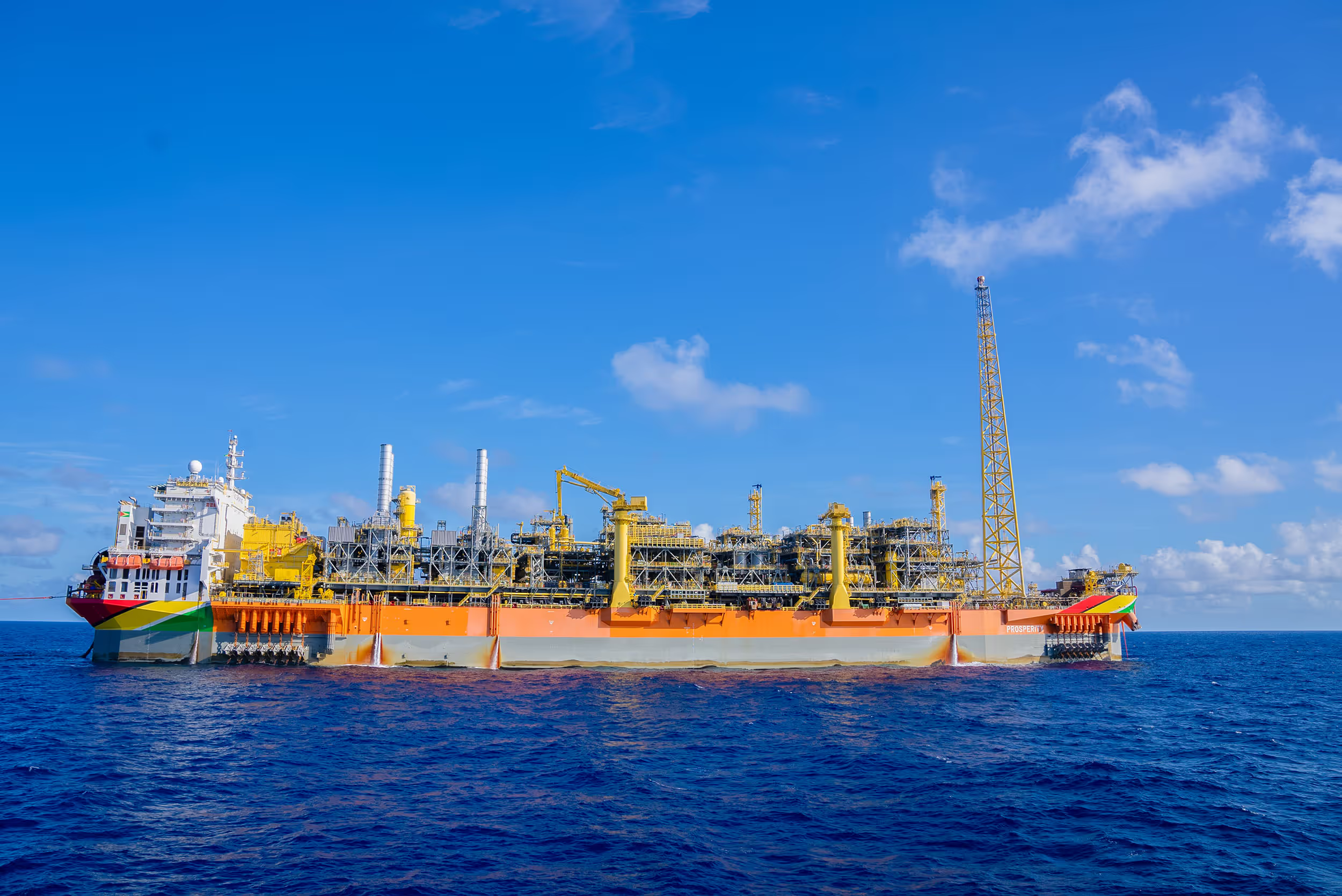
During the first half of 2026, Guyana had produced 163.3 million barrels of crude, averaging about 900,000 barrels per day. Four FPSOs were operating throughout the period, and the fifth, Errea Wittu, is expected to add another 250,000 barrels per day when it begins production in a few weeks time.
That rapid increase can make it easy to think of production as the beginning and end of the petroleum story.
It is neither.
An oil field goes through several stages: exploration, appraisal, development, production and eventually abandonment or decommissioning.
Each stage requires different investments, skills, equipment and government oversight.
Exploration is where companies spend money looking for hydrocarbons without knowing whether a commercial discovery exists.
A discovery then has to be appraised.
Companies drill additional wells and gather geological and reservoir information to determine the size and quality of the resource and whether it can be produced commercially.
That is followed by development.
This is where the numbers become much larger.
Wells have to be drilled. Subsea equipment has to be installed. Pipelines and gathering systems have to be put in place. An FPSO has to be constructed, transported and commissioned.
Guyana has been moving through that development stage at extraordinary speed.
The four existing FPSOs have pushed production close to 900,000 barrels per day, while the fifth vessel is expected to take national production beyond one million barrels per day.
But production itself is only one phase.
A field then enters a period in which the operator has to maintain wells and facilities, manage declining reservoirs where applicable, drill additional wells and determine how to maximise recovery while controlling costs and environmental risks.
Eventually, production declines.
The question then becomes what happens to the wells, subsea equipment, pipelines and production facilities.
Guyana's Petroleum Activities Act specifically covers the full life cycle of petroleum operations, including decommissioning. Attorney General Anil Nandlall said at the 2026 Guyana Energy Conference that the legislation also establishes a decommissioning fund to ensure environmental liabilities are covered after operators leave.
Guyana's newer deepwater PSA template requires annual contributions to a decommissioning fund, with the objective of having the full estimated cost funded two years before decommissioning and abandonment activities are expected to begin.
The agreement also provides for situations in which facilities could potentially be reused or relocated for another oil and gas development or an alternative energy or marine purpose, subject to government and regulatory approval.
That gives Guyana a useful reminder about the petroleum industry.
The money does not only come during production.
Large amounts of capital are spent before the first barrel is produced, and significant obligations remain after the last barrel.
It also explains why today's production numbers cannot simply be extrapolated indefinitely.
Guyana's output is rising because new FPSOs and wells are coming online. The country's fifth FPSO is expected to push production beyond one million barrels per day, with further expansion planned.
But every field ultimately has a production profile.
The industry therefore has to be managed across decades rather than judged only by the next quarter's output.
The challenge for the country is to use that period to build infrastructure, businesses, skills and institutions that remain valuable when individual oil fields eventually move into decline.
Guyana is therefore not at the end of its oil story.
It is not even close.
The country is moving rapidly through the exploration, development and early production stages of a major offshore petroleum industry.
The harder part will be managing everything that comes after the first million barrels per day headline.



.png)


.png)