













China’s presence in Guyana is increasingly visible on land, from infrastructure and vehicles to healthcare, energy and other projects.
But its biggest direct financial exposure to Guyana is not a bridge, hospital or solar farm.
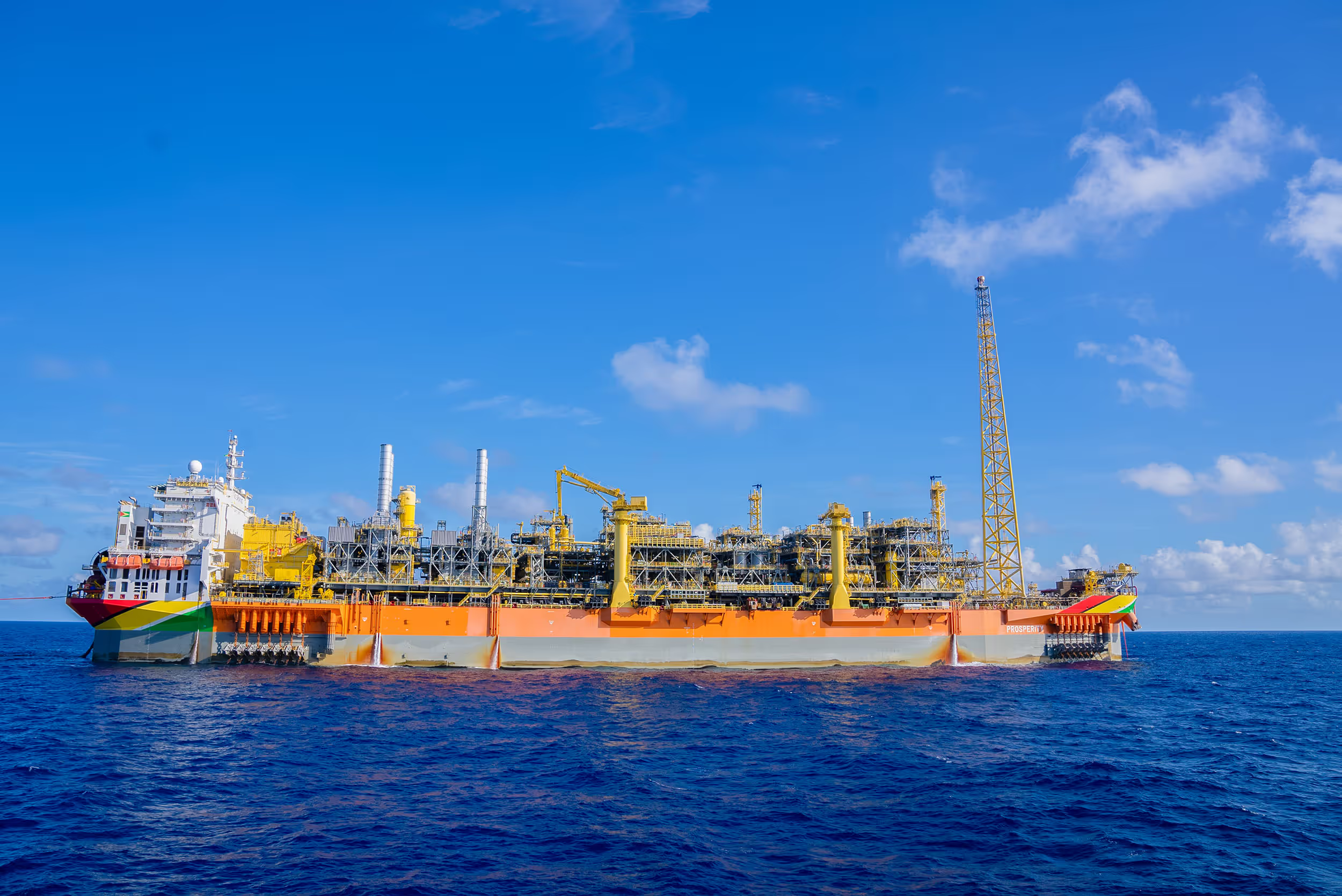
It is sitting roughly 200 kilometres offshore.
Chinese state-owned oil company CNOOC holds a 25% working interest in the Stabroek Block, giving China a direct stake in the oil production that has transformed Guyana’s economy and is now generating billions of US dollars in export earnings and government revenue.
That exposure is becoming even more significant as Guyana moves into another major phase of oil production.
The country is already producing more than 900,000 barrels of crude per day, according to the government, and is expected to cross one million barrels per day with the start-up of the fifth FPSO, Errea Wittu, for the Uaru development.
For CNOOC, that means the expansion of Guyana’s oil industry is also an expansion of one of its most important overseas oil investments.
The scale of that exposure was highlighted by the International Energy Agency.
The IEA estimates that CNOOC’s cumulative investment across the six Stabroek developments has reached approximately US$17.7 billion, making Guyana the company’s largest overseas upstream commitment.
CNOOC is responsible for 25% of the costs of the developments because it owns a quarter of the Stabroek Block. For the US$12.7 billion Whiptail development, for example, the IEA estimates CNOOC’s share of the investment at about US$3.18 billion.
The structure is important.
CNOOC does not operate the block. ExxonMobil is the operator with a 45% interest, while Hess holds 30% and CNOOC holds the remaining 25%.
But CNOOC participates in the investment and receives its corresponding economic interest from the block.
That makes the Chinese company a direct participant in Guyana’s offshore oil economy — not simply a contractor, supplier or infrastructure investor.
The Stabroek Block currently has four producing developments and installed production capacity of about 900,000 barrels per day.
The fifth development, Uaru, is now moving toward production.
The Errea Wittu FPSO arrived offshore Guyana in August and is expected to begin production in the fourth quarter of 2026, with a design capacity of about 250,000 barrels per day. The government says its start-up will push national production beyond one million barrels per day.
Then comes Whiptail.
The sixth Stabroek development is designed to add another 250,000 barrels per day and is expected to come on stream in 2027. The IEA says the project contains more than 850 million barrels of recoverable resources.
That means CNOOC's 25% interest is not tied only to the oil Guyana is producing today.
It extends into the next wave of production.
There is another reason CNOOC’s position matters now.
Guyana’s economic position under the 2016 Production Sharing Agreement has changed substantially as development costs have been recovered.
President Irfaan Ali said in August that Guyana’s entitlement had increased to 39.8%, compared with the 12.5% share it received while the project was heavily weighted toward cost recovery. He said the change resulted from the earlier recovery of the project’s cost bank.
That does not mean Guyana owns 39.8% of the Stabroek Block.
The contractors still hold their contractual interests — 45% for ExxonMobil, 30% for Chevron and 25% for CNOOC.
Rather, the figure reflects Guyana’s share of the production available under the PSA after royalty and cost recovery mechanisms are applied.
That distinction matters because the amount of oil being produced is rising at the same time as a greater portion of production is becoming available as profit oil.
The financial scale is already visible.
Guyana exported US$15.05 billion worth of crude oil in the first half of 2026, according to the government's mid-year report, with average production rising to about 902,000 barrels per day from roughly 639,000 barrels per day during the same period in 2025.
The government is projecting petroleum revenues of nearly US$6.5 billion for 2026.
CNOOC therefore has a direct financial interest in a sector that is becoming an even larger part of Guyana’s economy.
This is where the China-Guyana relationship becomes more complicated than the familiar images of bridges, hospitals and other Chinese-linked projects.
China is an important infrastructure and trading partner.
Chinese companies are involved in construction, equipment, vehicles, energy and other areas of Guyana’s expanding economy.
But CNOOC's position is different.
A Chinese state-owned company is a quarter-owner of the country's largest oil-producing asset.
And that asset is responsible for the overwhelming majority of Guyana’s export earnings.
CNOOC’s own 2025 annual report identifies the Stabroek Block as one of the world's major exploration hotspots and confirms its 25% interest. The company also reported that two Stabroek discoveries, Lukanani and Ranger, were successfully appraised during 2025.



.png)

.jpg)