















.jpg)
Guyana’s oil boom may have captured global attention, but the United States now appears to be looking beyond petroleum, eyeing the country as a potential technology, AI, and data infrastructure hub for the hemisphere.
That message came into sharp focus on Wednesday during a press roundtable at the U.S. Embassy in Georgetown, where U.S. Under Secretary of State for Economic Growth, Energy, and the Environment Jacob Helberg spoke openly about artificial intelligence, data centres, Silicon Valley partnerships, and America’s long-term economic strategy in the region.
Helberg described Guyana as a country uniquely positioned to “leapfrog old infrastructure” and participate directly in what he called the global AI revolution.
“We’re currently living through an incredibly transformative time in the technology sector, particularly with respect to the artificial intelligence revolution,” Helberg said. “President Ali is totally committed to ensuring that Guyana plays an important part in that technological revolution.”
The comments come as the United States recalibrates its global trading relationships amid increasing geopolitical competition with China and growing concerns over supply chains, technology security, and strategic resources.
Helberg made it clear that Washington is now deliberately identifying which countries it wants as long-term economic and strategic partners.
“We are currently recalibrating our trading relationships and making very affirmative, deliberate decisions on who our most trusted partners are going to be for the next 25 to 30 years,” he stated.
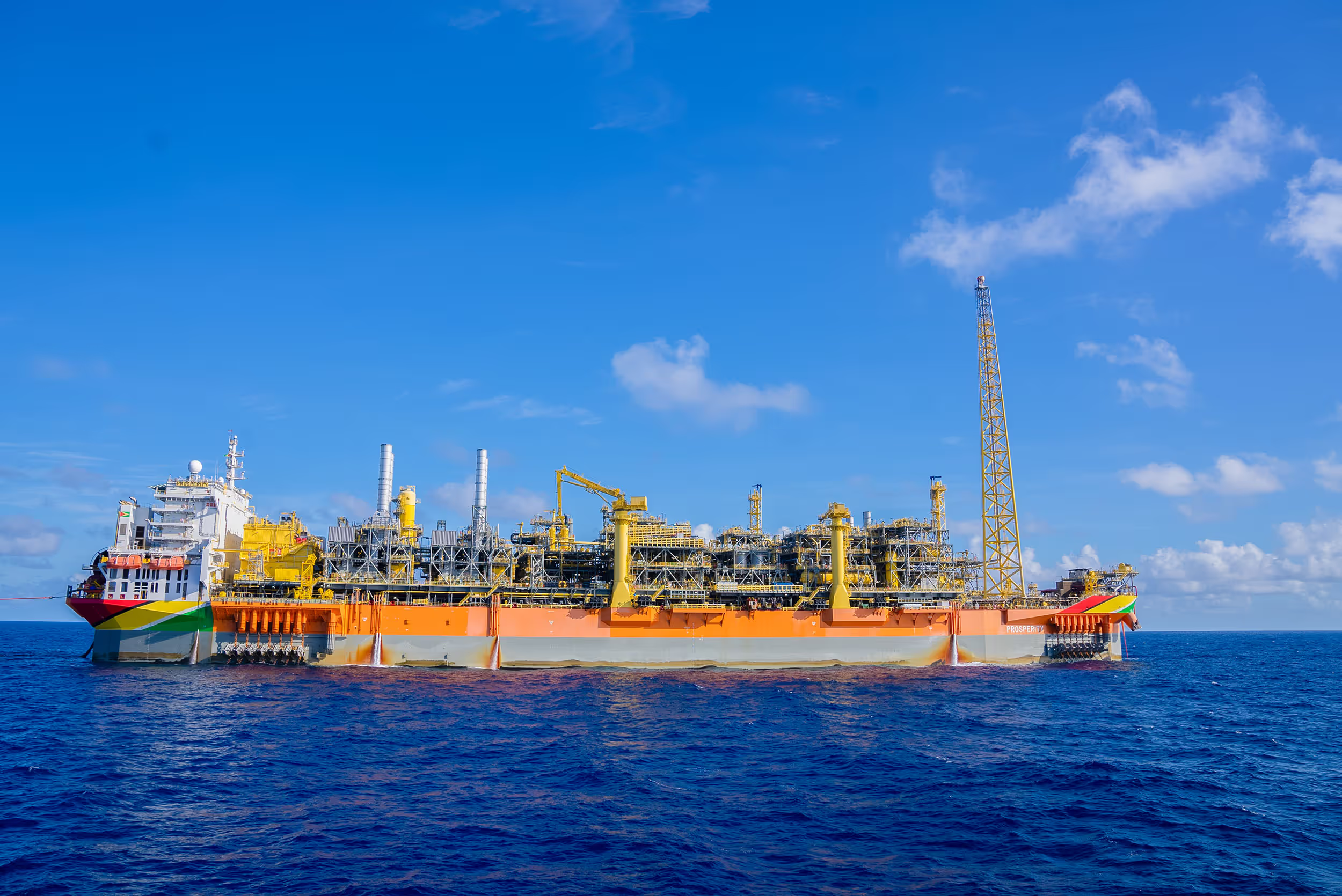
While Guyana’s international profile has largely been built around oil production led by ExxonMobil, Wednesday’s discussions signaled that Washington increasingly sees the country as having broader strategic importance.
Helberg revealed that discussions with President Irfaan Ali touched heavily on data centres, AI-enabled logistics, technology transfer, agri-tech, and entrepreneurship partnerships involving Silicon Valley.
The discussions build on previous public comments by the Guyanese government about positioning the country as a regional digital economy hub powered by low-carbon energy through the Gas-to-Energy project and future renewable energy expansion.

Guyana has already attracted growing interest from international technology firms because of its geographic location, political stability, expanding energy capacity, and rapidly growing economy.
Helberg suggested the U.S. private sector could become deeply involved if Guyana creates the right investment climate.
“The American private sector has over US$55 trillion of floating assets,” he noted. “Ultimately, that is the single biggest pool of investment that will be most beneficial to Guyana.”
One of the more striking elements of the discussion was Helberg’s vision of Guyana becoming an AI-powered logistics corridor connecting northern Brazil to Caribbean shipping routes.
He argued that current trade routes force northern Brazilian commerce into long and costly detours, while Guyana’s geography presents an opportunity to dramatically shorten shipping timelines.
The proposal aligns with years of discussions surrounding the Linden-to-Lethem road corridor, cross-border trade expansion with Brazil, and Guyana’s ambitions to become a transportation gateway between South America and the Caribbean.
Helberg said AI and automation technologies could transform Guyana into what he described as a “22nd century logistics corridor.”
The comments are likely to fuel further debate over whether Guyana’s next economic transformation could extend beyond oil and into technology-enabled infrastructure and services.
The remarks also reflect a broader shift in U.S.-Guyana relations under both the Ali administration and the Trump administration’s renewed Western Hemisphere strategy led by Secretary of State Marco Rubio.
Washington is already Guyana’s largest foreign investor largely because of ExxonMobil’s operations offshore, but officials now appear eager to expand cooperation into technology, minerals, agriculture, transportation, and digital infrastructure.
Helberg repeatedly praised Ali’s leadership style, describing him as “decisive” and ambitious in pursuing modernization.
“We think the momentum is there,” he said. “We think the leadership of both our nations are inclined to take this bilateral partnership to the next level.”



.png)