















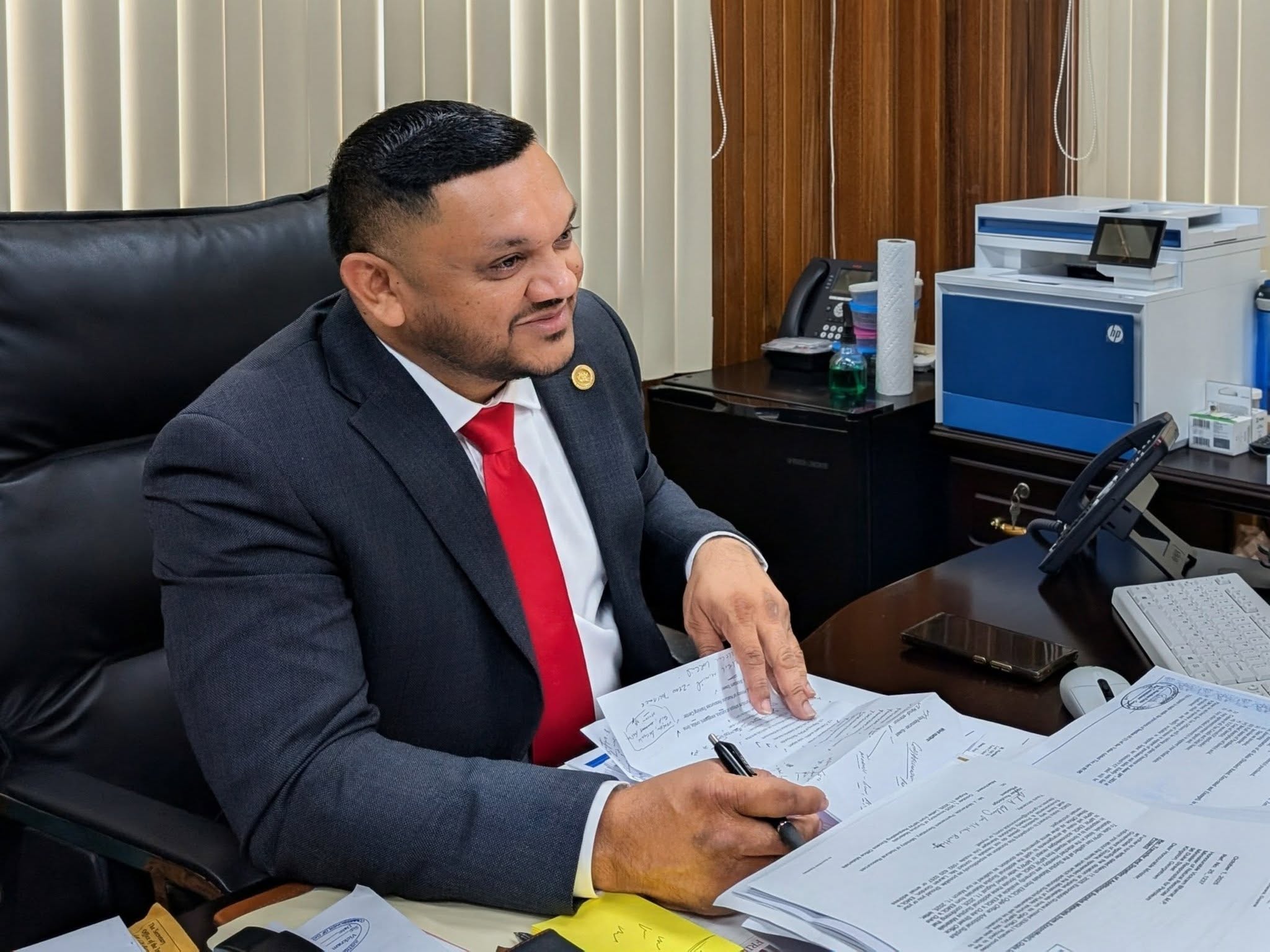
Minister of Natural Resources, Vickram Bharrat, on Tuesday declared that Guyana now stands among the best-managed new oil-producing nations in the world, as he underscored the government’s determination to ensure that wealth from the petroleum sector directly improves the lives of every Guyanese.
Speaking at the signing ceremony for the new Production Sharing Agreement (PSA) for Shallow-Water Block S4, Bharrat said Guyana’s approach to resource management is built on transparency, accountability, and a clear vision for sustainable development.
“We strongly believe that Guyana has one of the better managed oil and gas sectors in the world among new producers,” the minister stated. “And that is something that we are proud of and can go on the rooftops and shout about, because there is evidence to demonstrate it.”
Bharrat pointed to the country’s remarkable growth — from producing 80,000 barrels of oil per day in 2020 to approximately 920,000 barrels today — while maintaining full transparency of oil revenues through the Natural Resource Fund (NRF) and ensuring strict oversight of operations by both local and international regulators.
The minister said Guyana’s success is not measured by production figures alone, but by its commitment to sustainable and responsible development. He reaffirmed that the government will continue to pursue oil and gas exploration and production even as it expands its Low Carbon Development Strategy (LCDS 2030) and strengthens climate commitments.
“We are proud to say that Guyana has managed its oil and gas sector responsibly — maintaining high environmental standards while expanding opportunities for our people,” Bharrat said.
“We will continue to explore and produce our natural resources, but we will do so sustainably. Our policy is clear: our trees will not stand while our people fall.”
The remark drew applause from the gathering, as Bharrat explained that the government’s mission is to strike a careful balance between preserving the country’s world-renowned forests and ensuring that Guyanese enjoy the benefits of their natural wealth.
Minister Bharrat said Guyana’s progress is rooted in legislative and institutional reforms, including the Petroleum Activities Act, Local Content Act, and strengthened fiscal regime now governing all new petroleum agreements.
He noted that these reforms have introduced a 10% corporate tax, clearer penalties for non-compliance, and mandatory provisions for decommissioning and liability management — all designed to ensure that Guyana’s resources are developed responsibly and that investors are held to the highest standards.
“This is not about collecting penalties,” Bharrat explained. “It’s about ensuring that work programmes are completed, that there’s real production, and that Guyana benefits from every single barrel produced.”
The minister also commended the small but highly capable technical team at the Ministry of Natural Resources for their round-the-clock efforts to negotiate world-class agreements with oil majors such as ExxonMobil, Chevron, TotalEnergies, PETRONAS, and QatarEnergy.
“Many of the countries producing oil today have thousands of staff in their ministries,” he said. “We have a small, young, bright team that works tirelessly — sometimes overnight — to ensure every agreement we sign protects the rights of Guyanese.”
Bharrat said the success of Guyana’s oil and gas sector has defied global expectations and critics who once predicted that the country’s local content legislation would drive away major investors.
“They said the local content law would close down the oil and gas sector,” he recalled. “But today, we are attracting some of the biggest players in the world — QatarEnergy, TotalEnergies, PETRONAS — while delivering opportunities and benefits for Guyanese businesses.”
He announced that consultations have already begun to expand Schedule One of the Local Content Act to include more services and higher targets, ensuring that Guyanese workers and companies remain at the centre of the industry’s growth.
Bharrat said Guyana has learned from the mistakes of other petroleum-producing countries, choosing instead to build a model that combines economic progress with environmental protection.
“We looked at best practices and the mistakes made by others and crafted a model that works for Guyana,” he said.
“Not many countries have been able to align rapid economic development with environmental sustainability. But Guyana has done it — and we will continue to do so.”
He added that the proceeds of the oil and gas sector are already transforming the country through massive infrastructure investments, new hospitals and schools, free tertiary education, and an aggressive housing programme.
“Our people deserve world-class facilities, a higher standard of living, and the same opportunities enjoyed in developed countries,” Bharrat said. “That is the purpose of this sector — to ensure our people rise while we protect what makes Guyana unique.”
Tuesday's signing of the PSA for the S4 Block — with TotalEnergies, QatarEnergy, and PETRONAS — marked the first agreement under Guyana’s new fiscal regime, featuring a US$15 million signing bonus and improved terms that will ensure the nation continues to reap lasting benefits from its oil wealth.



.png)