
















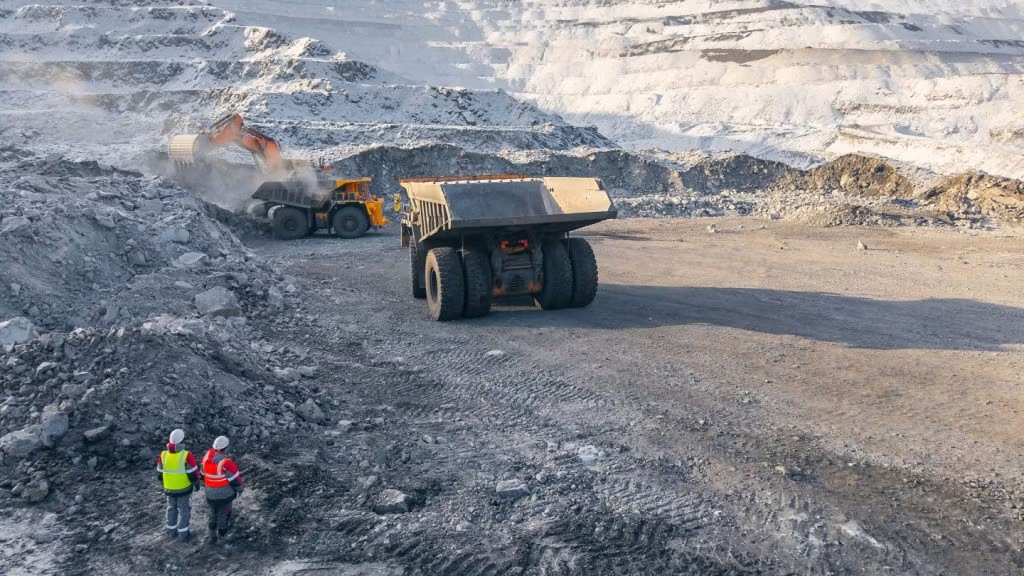
Guyana just celebrated Mining Week 2026, with the country’s mining sector being challenged to embrace a more modern approach to an industry that remains central to the non-oil economy.
The message from the Guyana Geology and Mines Commission (GGMC) during this year’s observances noted that while traditional mining remains an important part of Guyana’s history, the sector is becoming increasingly technology-driven, with greater emphasis on environmental responsibility, safety and compliance.
That transition is already visible in three areas — how deposits are identified, how gold is recovered and how people, equipment and supplies reach mining districts.
Data is moving prospecting closer to the digital age
One of the most significant changes is taking place before miners even begin digging.
In March 2026, the GGMC announced the release of new airborne geophysical datasets generated under the Guyana Mineral Advancement and Prospecting Strategy (GMAPS).
The 2025 survey covers more than 12,000 square kilometres and 37,000 line kilometres, with another 22,000 square kilometres and more than 135,000 line kilometres of legacy data reprocessed to the same standards. The datasets include magnetic, radiometric and gravity information.
The GGMC says the information can be viewed through accessible platforms and is intended to give miners a clearer picture of geological structures and formations, particularly in areas that are difficult to investigate from the ground.
For small and medium-scale miners, that could change the economics of exploration.
Instead of relying solely on traditional prospecting before committing substantial money to equipment, fuel, labour and logistics, operators can use geophysical information to help identify areas that warrant closer investigation.
The data, however, is not a guarantee of a gold discovery. It is an exploration tool that can help narrow the search and improve decisions about where more detailed geological or field work should be undertaken.
The GGMC's broader mapping programme includes detailed geological mapping, geochemical work and field validation of priority areas.
There is also an important distinction around access: the GGMC announced that the released 2025 map layers could be downloaded free of cost, while its current information-request system indicates that specific survey products or areas can also be requested through the Commission.
The second shift is happening inside the processing plant.
Mercury remains a major environmental concern in Guyana's small- and medium-scale gold-mining sector, and authorities are pursuing technologies that can reduce its use while improving gold recovery.
In May 2025, the Ministry of Natural Resources and the Artisanal Gold Council launched the 36-month Roadmap to Responsible Gold project.
The initiative is designed to pilot technologies that can reduce mercury use and support a pathway towards responsible and ultimately mercury-free gold production.
That work builds on the earlier planetGOLD Guyana programme, which demonstrated mercury-free processing systems in mining operations.
And there is evidence that the technology can make a substantial difference.
A planetGOLD comparison found that a mercury-free operation recovered more than 90% of the gold, compared with approximately 20% at a nearby operation using mercury. (planetGOLD)
The result should not be interpreted as meaning every mercury-free operation will automatically achieve a 90% recovery rate. Recovery depends on the ore, equipment and processing practices.
But it demonstrates the potential economic argument for changing the way gold is processed: better recovery can mean more gold recovered from material already being mined, rather than simply increasing the amount of material excavated.
The government is also maintaining regulatory controls around mercury. The GGMC says an Environmental Authorisation is required from the Environmental Protection Agency for importation, while the written consent of the GGMC Commissioner is required before mercury is imported for mining purposes.
The challenge now is getting more miners to adopt alternatives that are technically effective, affordable and practical for operations in remote areas.
The transformation is not confined to technology.
For an industry operating deep in Guyana's hinterland, roads, bridges and transportation networks are just as important as geological data and processing equipment.
In June, the government announced a US$6 million bridge across the Puruni River in Region Seven, with construction expected to begin in August and take approximately eight months.
The bridge is intended to provide safer and more reliable movement of people, equipment, goods and services for miners, businesses and communities operating in the mining district.
That could have implications well beyond convenience.
Moving excavators, fuel, spare parts and other heavy equipment into mining areas can be expensive and complicated. Better permanent infrastructure can reduce some of those logistical constraints and make access to mining districts more predictable.
The Puruni project forms part of a wider push to improve hinterland connectivity.
The 121-kilometre Linden–Mabura Hill road, for example, was reported at 86% completion in April, with 100 kilometres paved at that stage and completion targeted for August 2026. The road is designed to strengthen the connection between Guyana's coast and hinterland and improve trade and access along the corridor.
Given the importance of mining, forestry and other interior-based industries, those investments are becoming part of the sector's operating environment.
The push toward modernisation comes as mining continues to generate significant economic activity.
Region Seven accounted for 41% of Guyana's total gold production in 2025, with small and medium-scale miners declaring more than 105,400 ounces.
President Irfaan Ali said those operations generated about GY$88 billion in economic activity and that more than 1,100 small miners and 190 medium-scale operators directly and indirectly support thousands of jobs.
The president has also highlighted mining's wider economic footprint, pointing to businesses involved in transportation, retail, food services, mechanical and engineering services, banking and insurance that depend on activity in the sector.



.png)
.png)
.png)