
















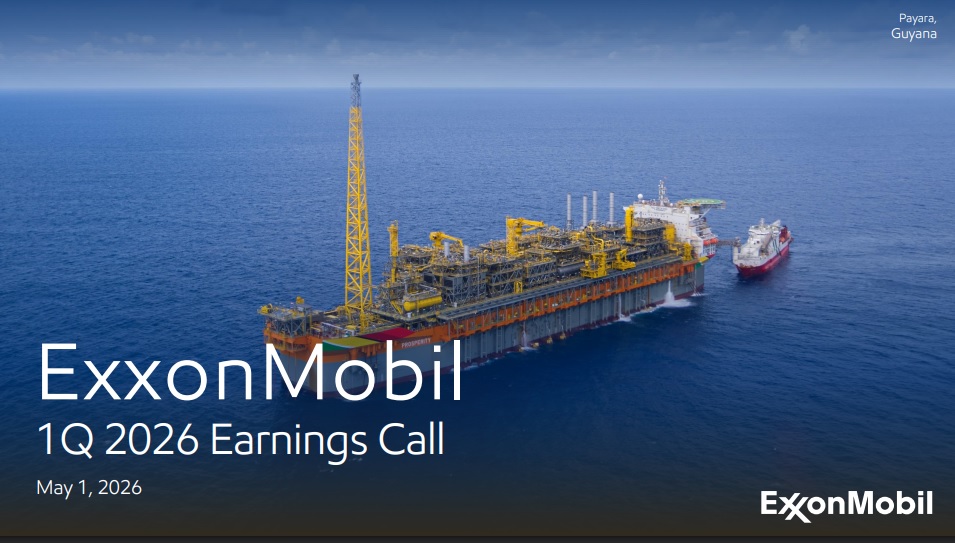
WhileExxonMobil’s headline profits declined in the first quarter of 2026 earnings report, compared to late 2025, its most important growth engine is increasinglyanchored in Guyana, which continues to outperform expectations and reshape thefirm’s upstream portfolio.
The U.S. oil giant reported earnings of $4.2 billion for the quarter, down from $7.7 billion a year earlier, reflecting timing effects, derivative valuation swings, and broader market volatility.
However, when adjusted for these distortions, underlying earnings rose to $8.8 billion, highlighting strong operational fundamentals rather than weakening demand.
At the center of this resilience is Guyana.
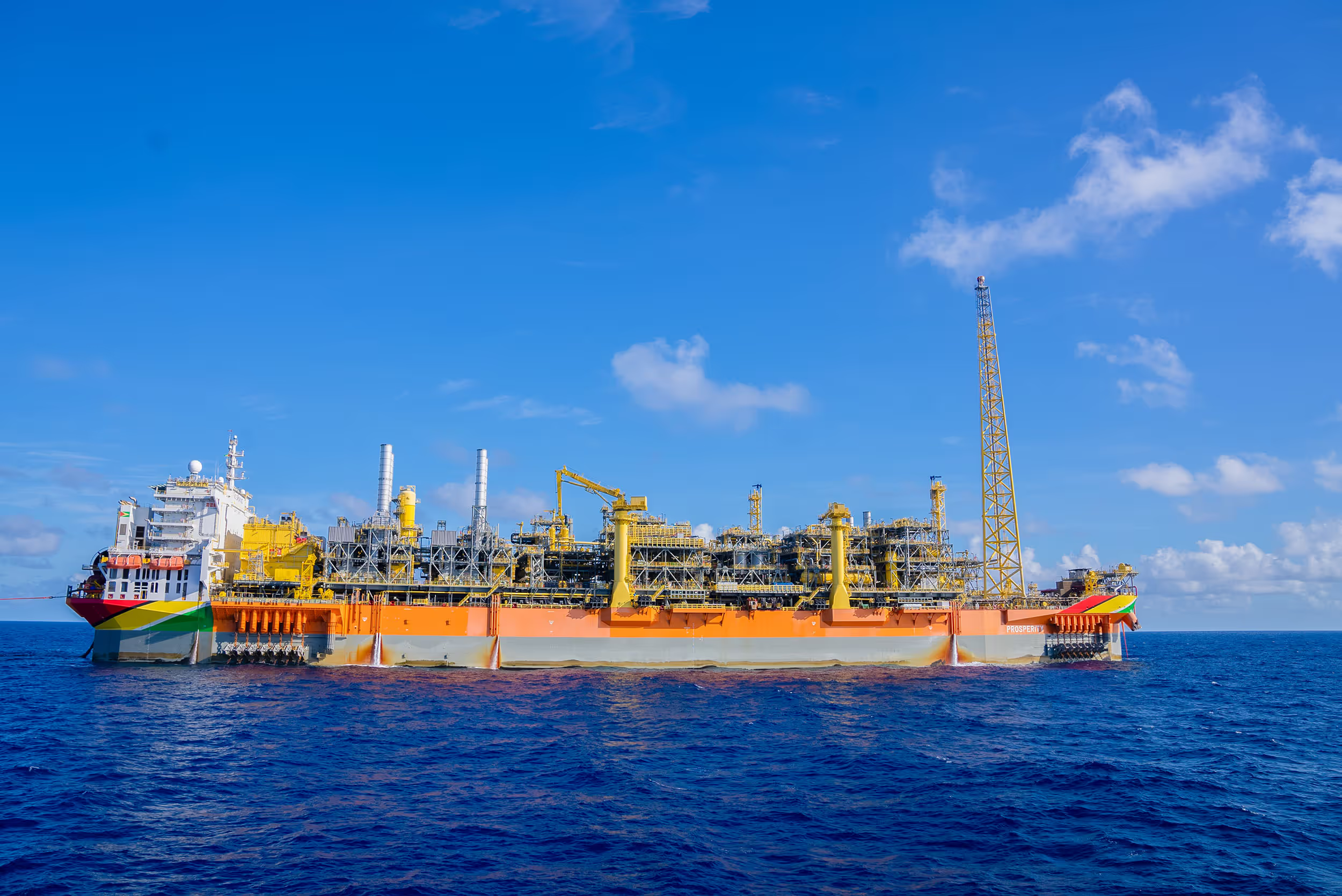
ExxonMobil confirmed that Guyana delivered record production of more than 900,000 barrels of oil per day in Q1 2026, making it one of the most productive offshore developments in the world relative to its size and development timeline.
The Stabroek Block, operated by ExxonMobil in partnership with Hess and CNOOC, has become the cornerstone of the company’s global “advantaged assets” strategy. These assets—also including the Permian Basin and LNG developments—are designed to deliver lower-cost, high-return production even in volatile price environments.
From Exxon’s perspective, Guyana is not just another oil project. It is now a core pillar of global upstream growth, driving volume expansion while offsetting declines and disruptions elsewhere, including Kazakhstan and the Middle East.
Yet the scale of growth raises broader questions: how quickly can production expand without infrastructure strain, and how sustainably can such rapid offshore expansion be maintained in a resource-dependent economy?
While Guyana’s output surged, Exxon’s overall upstream production fell to 4.6 million barrels of oil equivalent per day, down from nearly 5.0 million in the previous quarter. This decline reflects operational disruptions and geopolitical instability, including supply chain interruptions linked to Middle East tensions.
Despite this, Exxon emphasized that its strategy since 2018 has reshaped the company into a lower-cost, more resilient producer. Structural cost savings now total$15.6 billion since 2019, with a long-term target of $20 billion by 2030.
The company also returned $9.2 billion to shareholders in the quarter through dividends and share buybacks—an indication that capital discipline remains a central priority even as global markets fluctuate.
A notable feature of this quarter’s results is the scale of “estimated timing effects”—nearly $3.9 billion, largely linked to derivative pricing mismatches and inventory accounting adjustments.
This highlights a growing challenge for major oil firms: reported earnings increasingly diverge from underlying operational performance due to financial hedging and
Beyond oil, ExxonMobil’s broader strategy continues to lean heavily into gas and LNG expansion. The company achieved first LNG production at Golden Pass Train 1 in the United States, increasing U.S. LNG export capacity by approximately 5%.
This reinforces a key global trend: while renewables are growing, LNG remains central to energy security strategies across Europe and Asia, especially amid geopolitical instability.
Guyana, however, remains focused primarily on crude oil rather than gas monetization—meaning its fiscal exposure is tightly linked to oil price cycles.



.png)