















For years, one of the most misunderstood parts of Guyana's oil deal has been the question of cost recovery. How much of the oil produced offshore can be used by the companies to recover what they have invested, and when does Guyana begin receiving a larger share?
President Dr. Irfaan Ali sought to clarify that issue at his Tuesday press conference, as Guyana's rapidly expanding oil production moves beyond the levels seen when the Stabroek Block agreement was first negotiated.
The key development is that the ExxonMobil-led consortium has now recovered its initial investment costs, and according to the President, Guyana is now entitled to 39.8% of Stabroek Block production, up from the roughly 12.5% profit-oil share that characterized the early years of production.
That does not mean the Production Sharing Agreement has been rewritten.
Instead, it reflects how the existing agreement works once the contractor group's recoverable costs have been substantially recovered.
So, how does cost recovery work?
The simplest way to understand the Stabroek arrangement is to separate royalty, cost recovery and profit oil.
First comes the royalty
Under the 2016 Stabroek Block Production Sharing Agreement, the contractor pays Guyana a 2% royalty.
The royalty is calculated on petroleum produced and sold and is separate from the cost-recovery mechanism.
ExxonMobil's own explanation of the agreement says Guyana receives 50% of profit oil revenues, in addition to the 2% royalty.
Then comes cost recovery
The companies operating the Stabroek Block have financed the exploration, development and production of the resources.
The agreement allows eligible petroleum costs to be recovered from production.
The important number is 75%.
Up to 75% of production in a given period can be allocated toward recovering allowable petroleum costs.
But that does not mean ExxonMobil and its partners automatically receive 75% of the oil as profit.
It is oil used to recover costs.
If the companies have accumulated recoverable costs, the value of production allocated for cost recovery reduces that outstanding balance.
Guyana's Ministry of Natural Resources has also conducted audits of the contractor's cost-recovery claims, including examining whether costs were properly categorized and eligible under the PSA.
And then there is profit oil
Once allowable costs have been recovered, the remaining production is classified as profit oil.
That profit oil is shared equally between Guyana and the contractor group under the PSA.
This is where the famous 50/50 split comes in.
It does not mean Guyana receives 50% of every barrel produced.
It means Guyana receives 50% of the profit oil after the applicable royalty and allowable cost recovery.
That distinction is crucial.
Why Guyana initially received a much smaller share
In the early stages of production, the contractor group had billions of dollars in development and exploration costs to recover.
As a result, a significant portion of production could be allocated to cost recovery, leaving a smaller amount as profit oil.
If the full 75% cost-recovery ceiling were used, only 25% would remain as profit oil.
That 25% would then be divided equally — giving Guyana 12.5% and the contractor group 12.5% of production, plus the 2% royalty.
That is why the early structure is often described as Guyana receiving an initial take of about 14.5% of gross production value, before other fiscal considerations.
But that was never intended to mean Guyana would permanently remain at 12.5%.
The amount available as profit oil changes as the contractor's recoverable costs change.
The major turning point: the costs have now been recovered
ExxonMobil executives said during the company's second-quarter earnings call that the consortium had fully recovered the US$55 billion invested in Guyana, along with operating costs.
That recovery happened faster than originally expected.
Exxon attributed the acceleration to factors including the rapid pace of project development, lower development costs, strong operational performance and higher oil prices.
And that changes the economics of the production-sharing arrangement.
With the major initial investment recovered, a much greater proportion of future production can flow into the profit-sharing component rather than being used to recover the original investment.
That is why President Ali's announcement that Guyana's entitlement has risen to 39.8% is so significant.
The 75% figure is not a permanent Exxon share
This is perhaps the biggest misconception surrounding the agreement.
Exxon does not simply get 75% of Guyana's oil.
The 75% is a cost-recovery ceiling.
It is the maximum portion of production that can be allocated to eligible cost recovery in the applicable period.
If there are fewer costs to recover, the amount required for cost recovery can be lower.
And when less production is required for cost recovery, more oil falls into the profit-oil pool.
That means the amount Guyana ultimately receives can increase without changing the underlying 2016 PSA.
Why this matters now
Guyana's offshore production is also dramatically larger than it was when the agreement was signed.
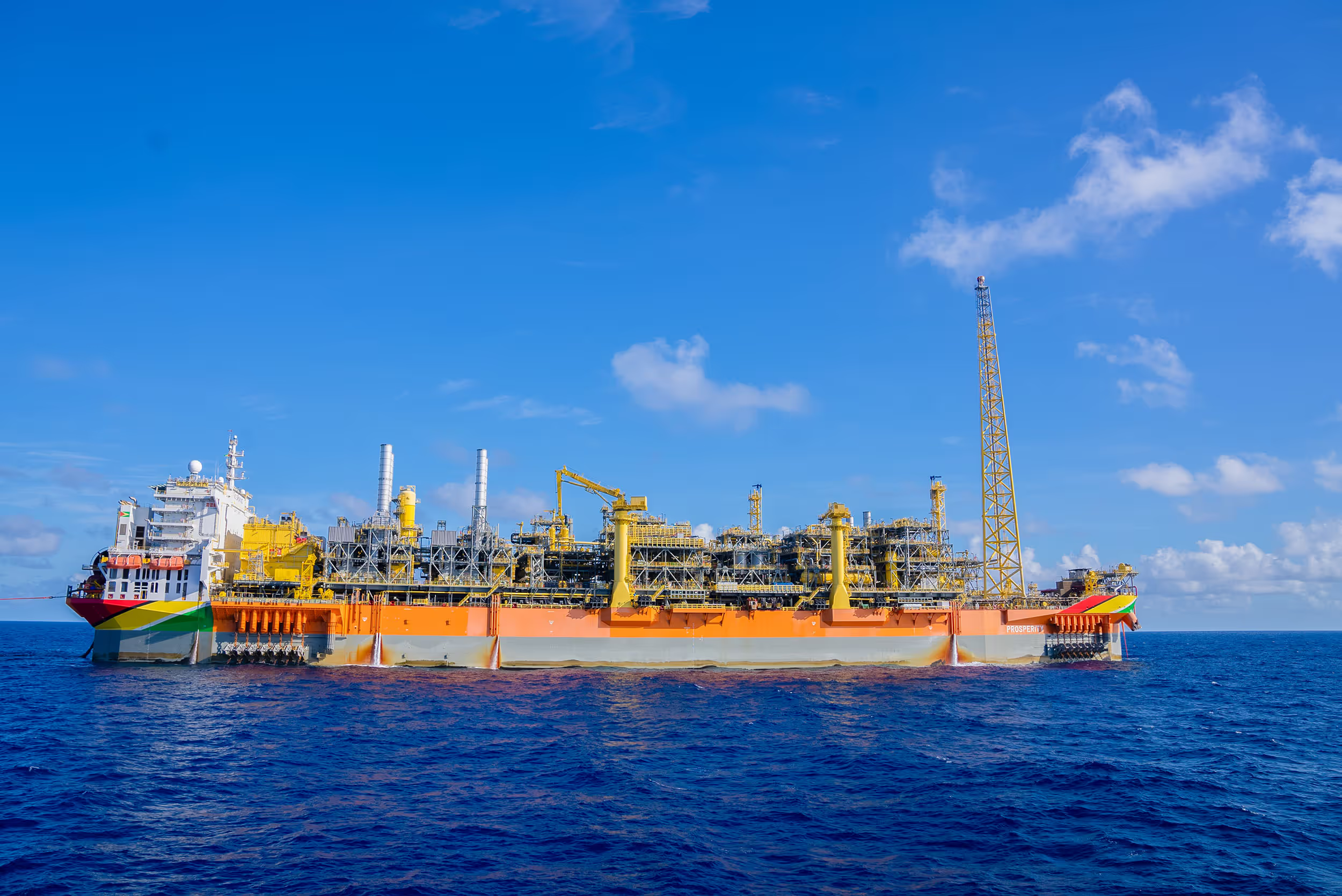
The country is now producing around 900,000 barrels per day, with additional FPSOs coming online.
Errea Wittu, the fifth FPSO, is expected to begin production later this year, while Jaguar is targeted for 2027.
Production is therefore expected to continue rising even as the proportion of production available to Guyana increases.
That creates a potentially powerful combination for the country's revenues: more barrels being produced and a larger share of those barrels flowing into the profit-sharing mechanism.
The simple version
The Stabroek arrangement can be reduced to four basic steps:
- Royalty
Guyana receives a 2% royalty. - Cost recovery
Up to 75% of production can be allocated toward eligible petroleum costs. - Profit oil
Production remaining after allowable cost recovery becomes profit oil. - Profit sharing
That profit oil is shared 50/50 between Guyana and the contractor group.
The critical point is that cost recovery is not profit.
It is the mechanism through which the companies recover eligible investments and expenses before the remaining profit oil is divided.
And now that ExxonMobil and its partners say the initial US$55 billion investment has been recovered, Guyana is moving into a materially different phase of the Stabroek Block's economics.
President Ali's 39.8% entitlement figure provides the clearest indication yet of that shift.



.png)
.jpg.jpeg)