














Remember when we were small and we used to beg to go outside?
Ah waan play!
There is something powerful about play, and even more powerful is an open, publicly accessible space.
We mus’ gah place fuh play.
It makes us want to go for a walk with our families, children and friends to lime and gyaff. It supports our athletes and fitness enthusiasts and encourages all Guyanese to be healthier.
At public parks, each of us find something different and necessary. A park in Guyana is a location of possibilities. It is where our country slows down, reconnects, laughs, and remembers what it means to deh good right hay.
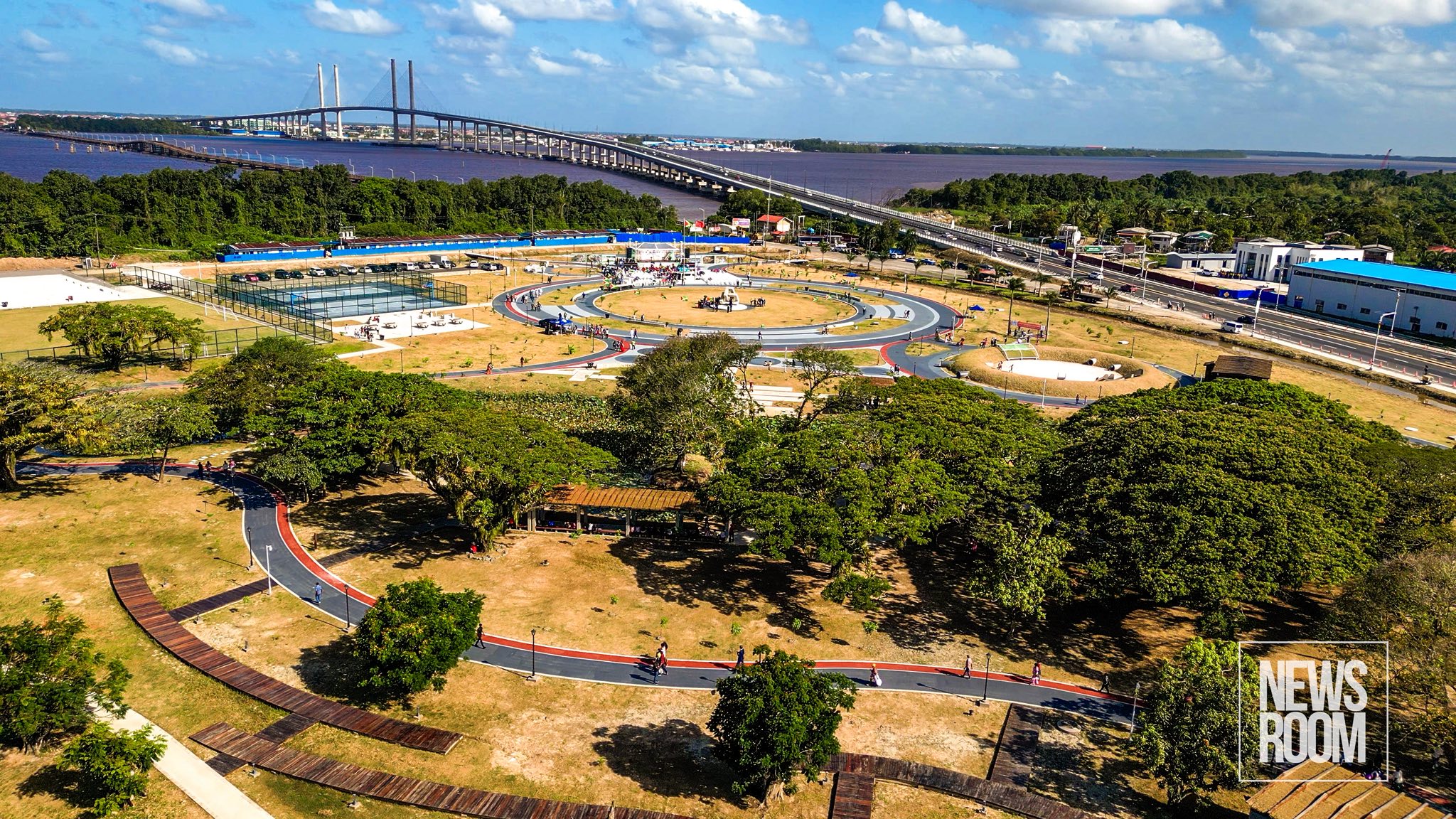
In Guyana, that vision is becoming more tangible with the recent opening of the Guyana–China Friendship Park, a modern, thoughtfully designed space that feels like a glimpse into what the future of public life could and should look like at home.
This weekend I took a walk with my family to this new park on the West Bank Demerara. There were children laughing as they climbed through tunnels and raced down slides. Nearby, many bounced on small trampolines, as the queue grew longer to take a turn. On the courts, severalbasketballs were being thrown into two nets, as two tennis matches were played on a large tennis court. A football game unfolded on a field behind, with players supported by cheers from friends and passersby.
This scene is not accidental. The park was designed as a multifunctional space, bringing together sports, leisure, and community life in one place. It includes basketball and tennis courts, a football field, jogging areas and play zones with slides and climbing nets, features that make it accessible to everyone, regardless of age or interest.
And beyond the activities, there is beauty.
Green spaces are everywhere for families to sit, picnic, and play. Walkways and seating areas invited me to take a rest (and I willingly obliged), with clean washrooms, and a gazebo style sitting area providing views of ponds filled with lotus flowers. Most striking of all in this green space, I watched as sanitation workers moved seamlessly through the park, picking up any garbage left behind (another conversation for another article).
This is what a park can be: a public space for us to enjoy outside of our homes.
There is also a rich history of the park that adds to its beauty. Formerly known as the Joe Veria Park, this space was once Plantation Meer Zorgen, a 19th-century Dutch-founded sugar estate that transitioned into a village following the abolition of slavery. The area was designated a park by Guyana’s Protected Areas Commission in 1982 and was donated to the Government as a gift to the people of Guyana by its former owner Mr.Joseph Rudolph Vieira, AA.
The importance of remembering the legacy and history of spaces like these cannot be overstated in Guyana. We now walk, run, skip and play over a historical site that has significantly shaped our lives as Guyanese.
Other parks across Guyana come to mind as we think about our nation’s history and well-being. At the National Park, for example, people have long gathered for exercise, sports, and relaxation, making it one of the country’s most important urban green spaces. The National Park shares a similar colonial history. It was once part of a sugar estate, PlantationThomas, before being established as the Demerara Golf Club. In 1965 it was named the Queen Elisabeth II National Park and later renamed the National Parkwhen the Union Jack was lowered, and the Golden Arrowhead raised for the firsttime at its location in May 1966.
In recent years, the National Park has been updated to include outdoor gym equipment, local shops and a designated play area for children, encouraging us in Georgetown to have a more active life.
Parks are not only about physical health. They are about clarity, the kind that comes from sitting under a tree and looking at the manatees. They are about connection, through picnics and painting sessions. They are about giving Guyanese people somewhere safe, positive, and inspiring to spend their time.
And in a fast-changing Guyana, it is about balance.
The development of the Guyana–ChinaFriendship Park signals something important: a recognition that development must be measured through the quality of the Guyanese life. One way to mark a better quality of this life is to ensure there are safe and accessible, open and public parks for us to jus deh.
As we think about the quality of the Guyanese life, conversations about parks cannot stop at building them, it must include maintaining them. The National Park, with its long history and central place in Georgetown life, already has the foundation: open fields, sports areas, and now outdoor fitness equipment. But like any shared space, it needs care to remain welcoming and functional. Equipment must be maintained. Courts need to be repaired. Green spaces must be preserved.
Imagine a National Park where every piece of equipment works as intended, where tennis courts are smooth and active, where families feel just as inspired as they do when visiting newer spaces. Imagine that same standard replicated across Berbice, Essequibo, Linden, Lethem, and in every Guyanese community with a publicly accessible park or community centre.
This call is urgent. In a recent News Room article, Dr Mahendra Carpen, Head of Medical Services and Cardiology at theGeorgetown Public Hospital Corporation, notes
“Younger populations in Guyana are increasingly presenting with serious heart conditions, not only from blockages, but also from weakened heart muscles and complications arising from uncontrolled hypertension, diabetes, and high cholesterol.”
We now must confront this with urgency: what if there were more public spaces for us to be healthy across Guyana?
What if every community had its own version of a friendship park?
- Spaces for sport and play
- Areas for relaxation and family time
- Fun activities for children
- Green lands in Guyana for us all to enjoy
Because dis land is we land fuh geh healthy, fuh enjoy weself, and fuh play.



.png)