
















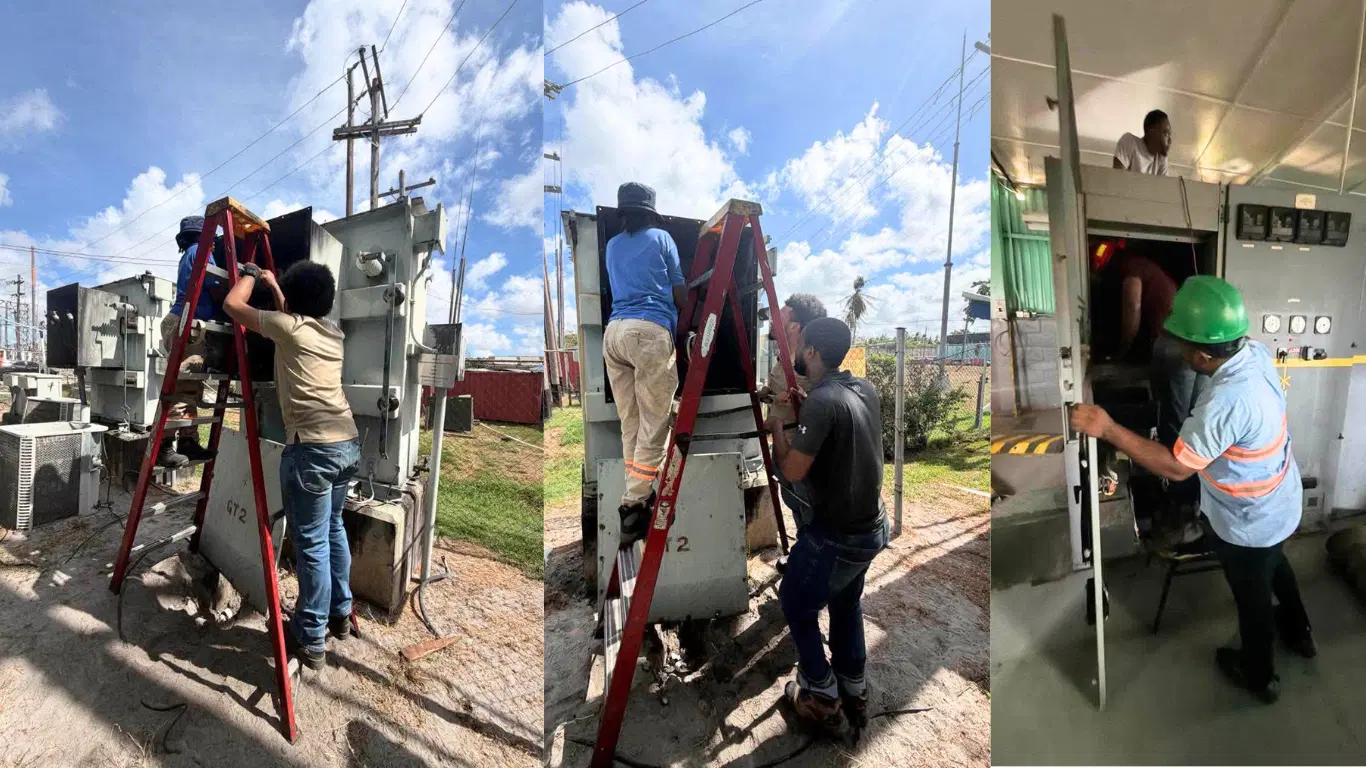
Residents of East Berbice-Corentyne were without electricity for two days, a gruelling ordeal that Guyana's President Dr. Irfaan Ali said will be followed by a "full and thorough review of the circumstances that led to this failure."
Many residents took to social media to complain of the hardships they were enduring — including loss of productivity, spoiled food and general discomfort.
So what happened?
The prolonged outage, which began on Thursday, was caused by an insulation failure in the panel housing the grounding transformer at the Canefield substation, Guyana Power and Light (GPL) Inc. said. The government-owned power company said several defective components had to be replaced.
In updates on its Facebook page, GPL said the repair works were being "undertaken carefully and methodically to ensure that all outstanding technical issues are addressed before electricity supply is safely restored."
By Saturday afternoon, with the outage exceeding 45 hours, President Ali called it "wholly unacceptable" and apologised to those affected. He said the public deserves more than assurances over the "enormous hardship" unfolding, and announced a review of the failure, which has been described as GPL's worst outage in recent history.
"Residents are entitled to a clear and honest explanation of the circumstances that led to this prolonged shutdown, and why restoration has taken so long.
"... There will be a full and thorough review of the circumstances that led to this failure, the adequacy and effectiveness of GPL's response, and the measures necessary to prevent a recurrence," President Ali said in a Facebook post.
Wider challenges
The restoration of power started on Saturday evening. However, this exercise was done incrementally as the distribution system went back offline during an initial restoration exercise.
GPL's Divisional Director of Engineering Services, Ryan Ross, said the "load growth" on the Corentyne Coast presented some challenges during the initial repowering exercise, prompting the incremental restoration.
Load growth has been one of the challenges increasingly affecting GPL, prompting blackouts.
At a September 2026 press conference, Head of the Executive Management Committee Kesh Nandlall affirmed that the company has enough generating capacity to supply electricity to consumers. However, faults along the ageing distribution system are emerging more frequently.
"The reality is that the distribution system is now facing challenges. That is, feeders are now being overloaded, transformers are being taxed and overloaded, and some people get voltage fluctuations," Nandlall told reporters.
Nandlall said there are ongoing investments in upgrading the grid but highlighted too that power demand continues to climb — outpacing the development of the upgrades and the introduction of the Wales Gas-to-Energy project.
Looking ahead, the first gas turbine at Wales is expected to begin supplying about 57 megawatts of electricity before the end of 2026, with additional generating capacity to follow in 2027.
The wider Wales development includes a 300-megawatt power plant and facilities to process natural gas transported from offshore through a pipeline. Once operational, the plant is expected to provide a substantial increase in electricity generation for the Demerara-Berbice Interconnected System, which is run by GPL.
For households and businesses, the anticipated benefits include a more reliable electricity supply and lower generation costs.
Simultaneously, a new transmission and distribution system is being developed to augment the improved power supply expected soon.