















From zero oil production in 2019 to roughly 900,000 barrels per day today, Guyana has become one of the world’s fastest-growing oil producers, and the climb is far from over.
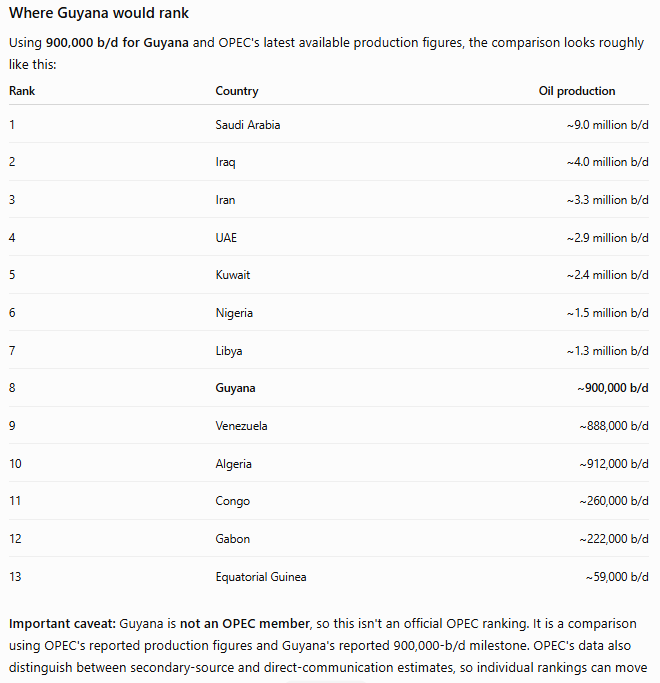
Guyana’s offshore output is already on par with, or above, the production of some smaller OPEC producers - (Organization of the Petroleum Exporting Countries).
At roughly 900,000 barrels per day, Guyana is now producing more oil than OPEC members Congo, Gabon and Equatorial Guinea, but remains behind, and in some cases on par with, the bloc’s larger producers including Venezuela, Algeria, Nigeria, Libya, Kuwait, the UAE, Iran, Iraq and Saudi Arabia.
Guyana is not an OPEC member, so this isn't an official OPEC ranking. It is a comparison using OPEC's reported production figures.
Guyana had turned down overtures to join OPEC in the past, with Vice President Bharrat Jagdeo saying in 2023 that the country needed to maximise oil production and profits in the short term rather than accept the production constraints that could come with membership.
Notwithstanding, Guyana is now producing oil at a level comparable with OPEC members Algeria and Venezuela and more than three times the output of Congo and about four times that of Gabon.
Guyana's 900,000 b/d is extremely close to Algeria's reported 912,000 b/d and above Venezuela's 888,000 b/d in the OPEC secondary-source data.
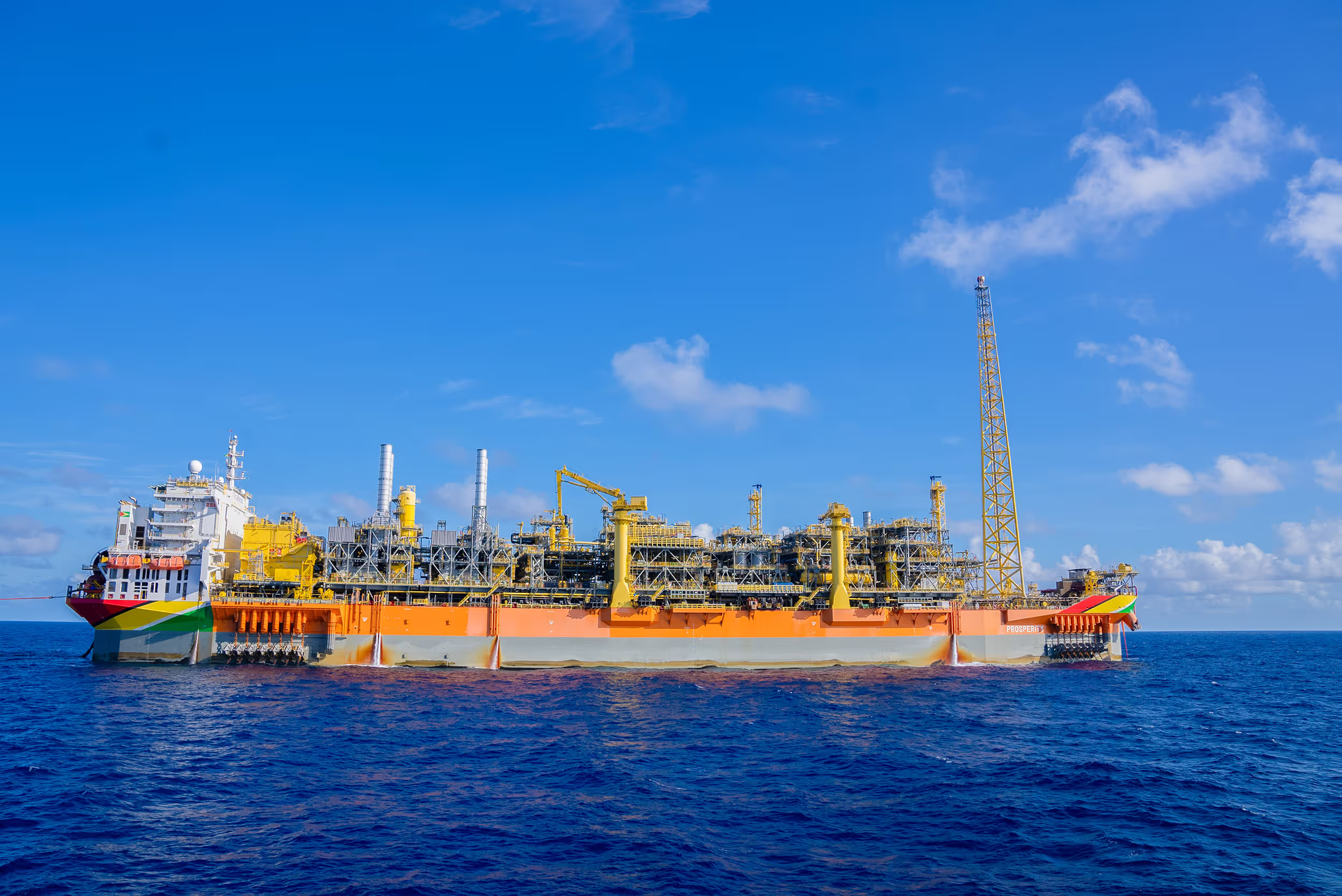
When the Liza Destiny started producing in December 2019, Guyana was producing about 120,000 barrels per day. Today, four FPSOs — Liza Destiny, Liza Unity, Prosperity and ONE GUYANA — are operating offshore.
And another major jump is coming.
Two more FPSOs, 500,000 barrels more.
The Errea Wittu, for the Uaru project, is expected to begin production in late 2026, followed by the Jaguar in 2027, which will produce for the Whiptail project.
Each FPSO is designed for roughly 250,000 barrels per day.
That means the two projects could add approximately 500,000 barrels per day to Guyana’s production capacity, potentially taking national output from around 900,000 barrels per day to roughly 1.4 million barrels per day, depending on ramp-up and operating conditions.
That would put Guyana firmly into the company of some of the world’s major oil-producing nations, despite having entered the industry less than seven years ago.
Unlike mature oil-producing countries where output can decline as older fields age, Guyana is still adding new production at a rapid pace.
The Stabroek Block has delivered more than 40 discoveries and an estimated 11 billion barrels of recoverable oil equivalent, creating a pipeline of projects that can continue adding production for years.
ExxonMobil has also described its Guyana operations as an “advantaged” asset, reflecting the quality of the resource and the economics of developing it.
The results are already showing up in Exxon’s global numbers. The company said growth from Guyana and the Permian Basin helped drive its highest upstream production in more than two decades.
The two 2027 projects are only part of the bigger picture.
Hammerhead and Longtail are among the other developments in the pipeline, while Exxon has indicated that a ninth FPSO would come around 2031.



.png)
.jpg.jpeg)