

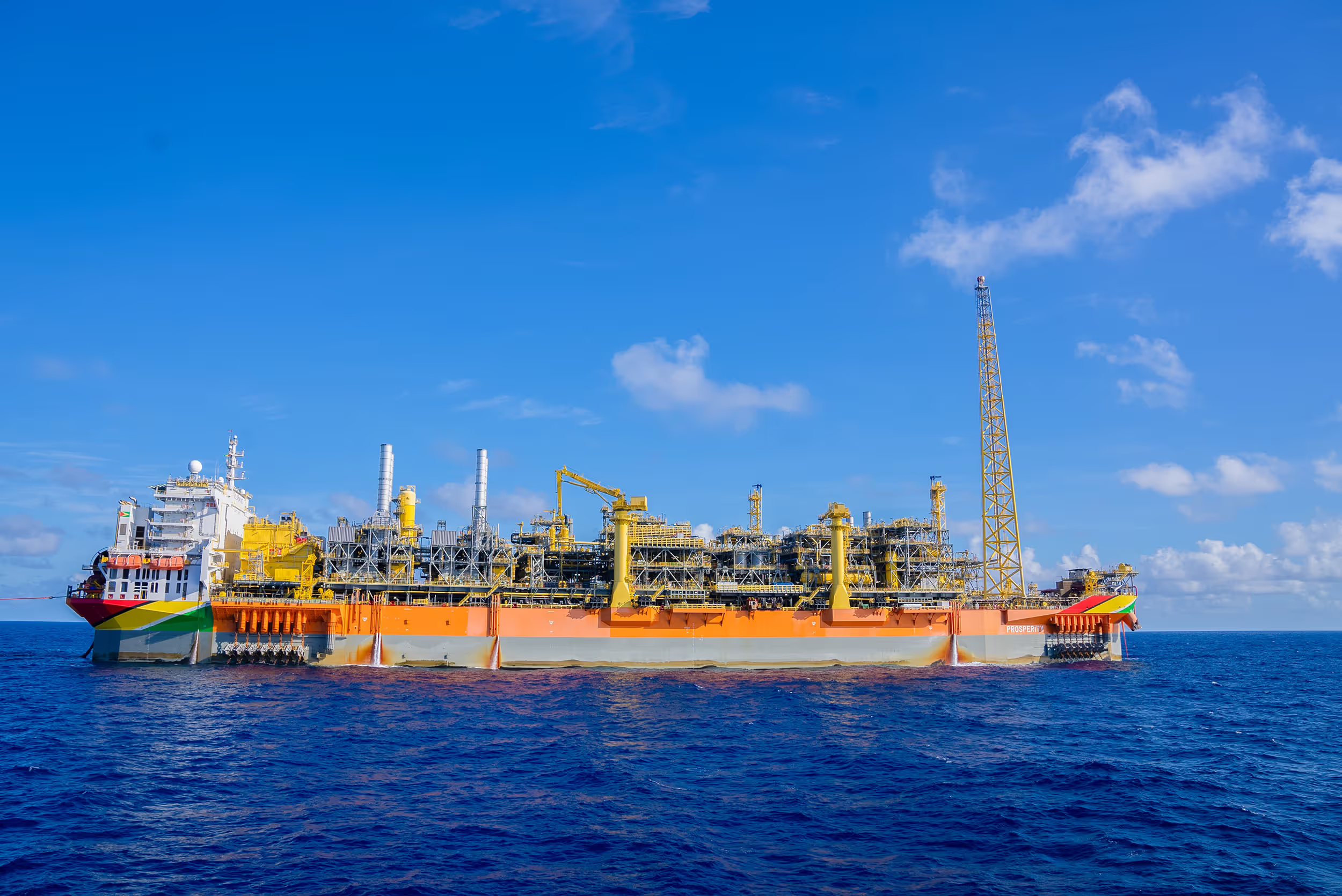
















Guyana has the gas offshore. The bigger question now is whether the country can build enough demand, infrastructure and local business capacity onshore to turn that resource into a new industrial economy.
That is where ExxonMobil Guyana President Alistair Routledge says the private sector has an important part to play.
Speaking at the Georgetown Chamber of Commerce and Industry’s 2026 Energy Luncheon on Thursday, Routledge said Guyana’s plans to bring more natural gas onshore, particularly into Berbice, will require more than government and ExxonMobil alone.
He said business groups and local companies need to help create the conditions that would give international investors confidence to put money into new industries.
The issue is becoming increasingly important as Guyana moves beyond its first major gas project at Wales and considers a much larger gas development in Regions Five and Six.
ExxonMobil has already spent about US$1 billion on the pipeline bringing gas from the Liza field offshore to the Gas-to-Energy facilities at Wales. That system is expected to begin supplying gas later this year.
The proposed Berbice pipeline would be a much larger undertaking. Routledge has previously estimated that it could cost about US$2 billion, but he has made clear that ExxonMobil needs to see sufficient demand for the gas before making such an investment.
At Thursday’s luncheon, he explained why.
“The paths that we’re on, with the Government, to bring that gas to shore at Wales and Berbice is a huge opportunity to deliver more jobs, more investments onshore – more industries – and to diversify the economic development of the country.”
But, he said, the challenge is connecting the offshore resource to industries that are prepared to buy and use the gas.
That could include additional electricity generation, data centres, aluminium-related industries and other large industrial projects.
“We need some significant gas demand in order to make the foundational investments in the pipeline to bring the gas onshore and all the associated infrastructure that goes with it,” Routledge said.
The proposed Berbice gas pipeline is therefore not simply a question of laying another pipe from offshore to shore.
For ExxonMobil, the commercial case also has to be clear.
Routledge said potential investors need answers on issues such as how much gas will be available, what industries they can invest in, what the investment terms will look like and which local partners they can work with.
That, he said, creates an opening for organisations such as the GCCI, Private Sector Commission and business chambers in Berbice.
“[They] have a vital role to play. A vital role in helping those with capital and those with expertise to come into Guyana and deploy it wisely,” Routledge said.
He also pointed to a more basic issue: where exactly the new industrial activity will happen.
Discussions are continuing over the location of the proposed development zone in Berbice, including where major facilities such as a deep-water port would be established.
Routledge said uncertainty over the physical location of these facilities makes it harder for outside investors to see a clear path into the market.
“Until we can say, ‘Here is the land where everything will be built; here is where the deep-water port will be’, there is not a lot of belief externally that there is a roadmap for how this will happen,” he said.
While government would have a leading role, Routledge argued that the private sector should also help shape those decisions because businesses already have knowledge and expertise that could contribute to the planning process.
He said the country needs to move quickly on providing that clarity.
The potential economic impact extends well beyond using gas to generate electricity.

Public Utilities and Aviation Minister Deodat Indar told the same luncheon that local companies need to start preparing now for the industries that could develop around Guyana’s gas resources.
He pointed to opportunities in gas utilisation, storage, transportation and downstream processing.
Indar also highlighted products that can be derived from components of natural gas, including C5+ hydrocarbons and isobutanes, as well as potential applications in refrigeration and fertiliser production.
“If you don’t know about gas, you have to learn. You have to bring somebody who knows or find a partner who understands the business,” Indar said.
Government has already moved toward establishing local cooking-gas bottling capacity, while the larger Berbice development could create demand for a much wider range of services and industries.
Indar said the scale of the proposed Berbice development means businesses should also be preparing for work involving gas pipelines and related infrastructure.
“Berbice Development is a whole new ball game because that side will have more gas available for use on land,” he said.
For Guyanese businesses, both officials framed the gas build-out as an opportunity to participate in an economy that is expected to become increasingly industrialised.
The potential work extends beyond traditional oilfield services.
Logistics, transportation, warehousing, construction, certification, specialised technical services, training and waste management are among the areas where local companies could see new demand.
The larger objective is to create an ecosystem around the gas rather than simply produce it.
ExxonMobil has previously said the Berbice gas development could support larger volumes of gas for onshore industries and attract investment from companies beyond the oil producer itself.



.png)