















When the Liza Destiny began producing oil offshore Guyana in December 2019, it marked the country's entry into the ranks of oil-producing nations.
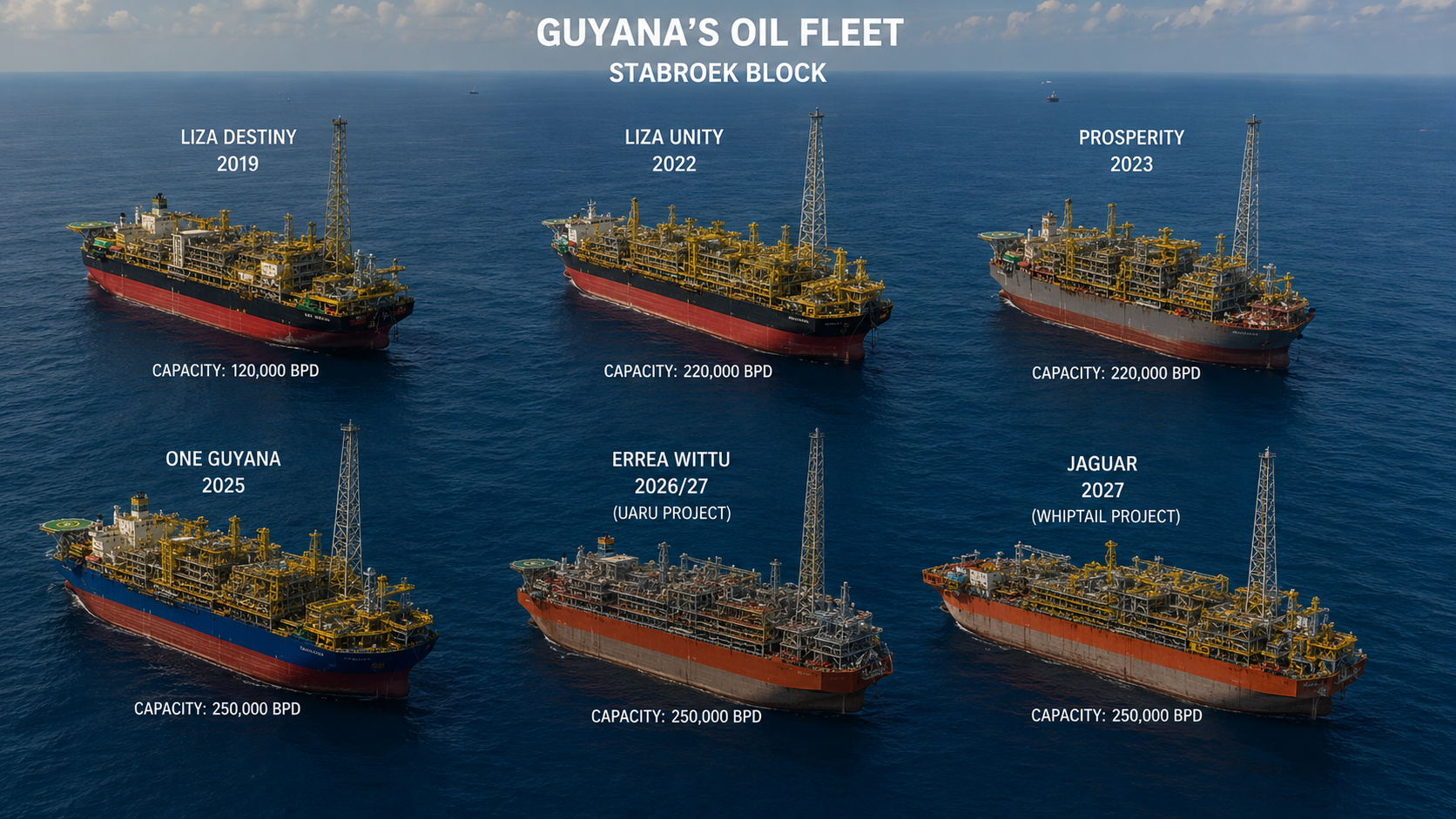
Less than seven years later, Guyana has four producing floating production, storage and offloading (FPSO) vessels operating simultaneously, is preparing to commission a fifth -Errea Wittu- before the end of 2026, and is already planning for a ninth production vessel by around 2031.
A sixth FPSO - Jaguar—is expected to begin production in 2027. That means Guyana's offshore fleet is on a trajectory from four producing vessels today, to six by 2027, and potentially nine by 2031—an extraordinary expansion in just over a decade.
For ExxonMobil and its Stabroek Block partners—Hess and Chevron—few deepwater developments anywhere in the world have expanded as quickly.
The pace of development has become one of Guyana's defining competitive advantages, allowing the country to move from first oil to an estimated 900,000 barrels per day in record time while continuing to unlock billions of barrels of additional resources.
Each FPSO represents a new offshore development capable of processing, storing and exporting crude oil from multiple subsea wells. Unlike traditional offshore platforms, FPSOs are floating facilities that can remain at sea for decades while serving entire oil fields.
Guyana's current production fleet consists of:
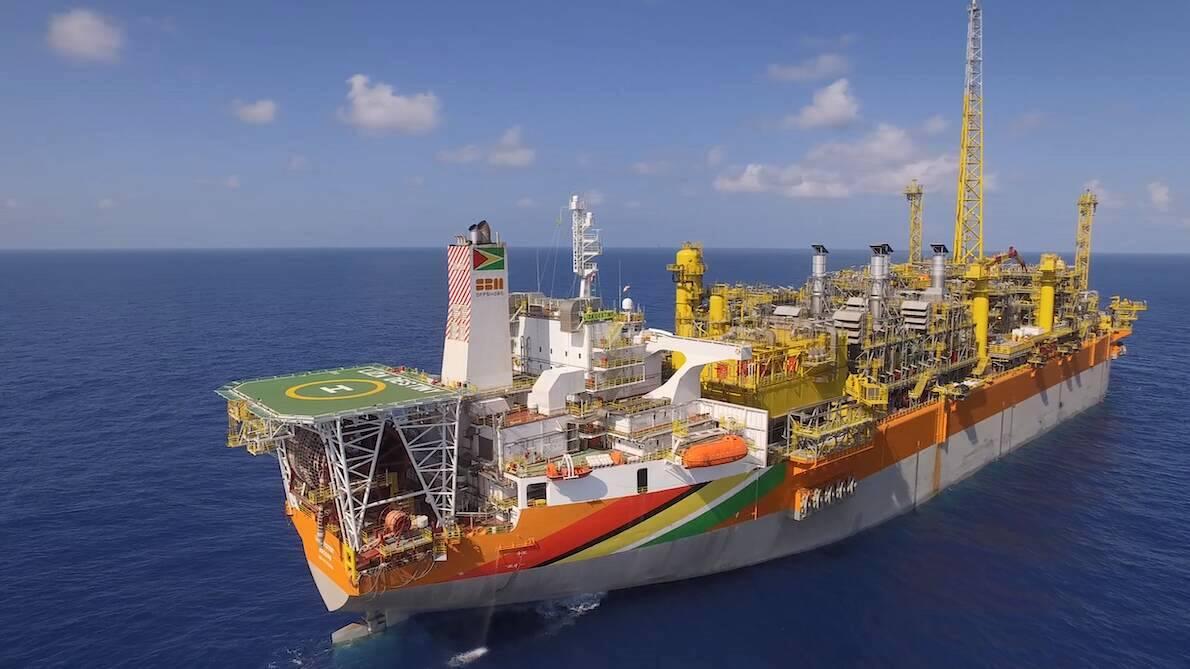
Liza Destiny
First oil: December 2019
Guyana's first producing FPSO launched the country's petroleum era.
Originally designed to produce about 120,000 barrels per day, operational improvements have enabled the vessel to consistently exceed its initial design capacity.
Liza Destiny proved that Guyana's offshore discoveries could be developed commercially and laid the foundation for every project that followed.
.jpeg)
Liza Unity
First oil: February 2022
The second FPSO nearly doubled national production capacity.
Designed for approximately 220,000 barrels per day, it demonstrated how Exxon could quickly replicate successful project designs while reducing execution risk.
.jpeg)
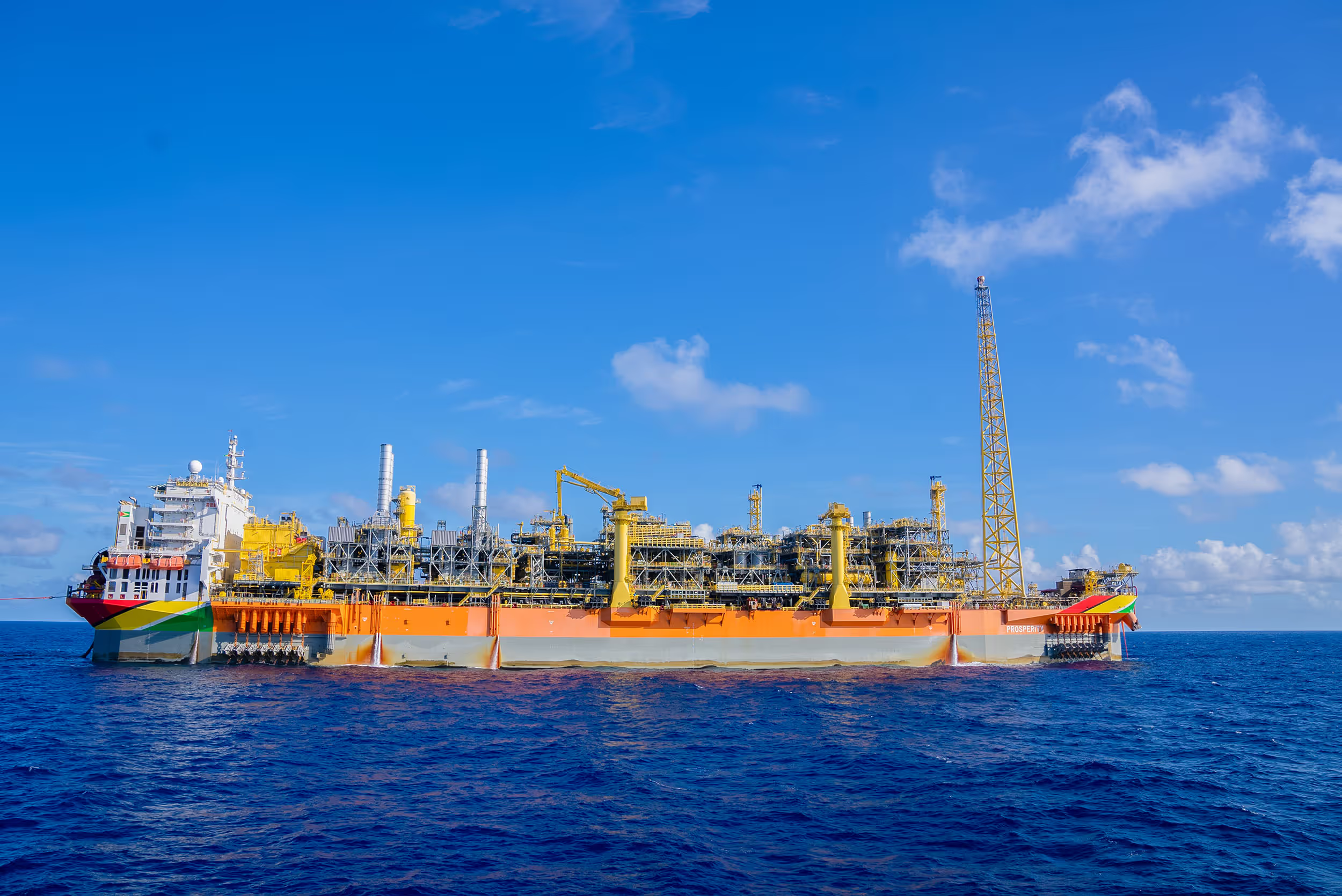
Prosperity
First oil: November 2023
The Prosperity FPSO, supporting the Payara development, continued Guyana's rapid expansion.
Like Liza Unity, it has a production capacity of about 220,000 barrels per day and further strengthened Guyana's position among the world's fastest-growing oil producers
.jpeg)
ONE GUYANA
First oil: 2025
The country's fourth FPSO pushed offshore production to roughly 900,000 barrels per day during the second quarter of 2026.
Its arrival marked another milestone—not only increasing output but also demonstrating Exxon's ability to deliver successive projects on schedule using increasingly standardized designs.
Errea Wittu: Expected online later in 2026, the vessel will support development of the Uaru project.
Once operational, Guyana's production capacity is expected to exceed one million barrels per day for the first time.
Beyond Uaru, Exxon has secured government approvals or is advancing plans for several additional offshore developments.
Jaguar: The Jaguar project forms part of the company's longer-term development strategy and is expected to build on the success of previous FPSOs.
Longtail represents another major offshore project currently advancing through engineering and planning.
Unlike earlier projects, Longtail is expected to incorporate both oil production and significant natural gas development, reflecting the growing scale and complexity of Guyana's offshore portfolio.
Ninth FPSO
In its second-quarter earnings presentation, Exxon confirmed it is continuing work toward a ninth FPSO targeted for start-up around 2031, reinforcing the company's long-term commitment to Guyana.
Although details have not yet been announced, the disclosure signals that Exxon expects sufficient discovered resources to justify continued large-scale investment well into the next decade.
Building nine offshore production vessels in just over a decade would normally be an extraordinary challenge.
Yet Exxon has repeatedly highlighted Guyana's "design one, build many" strategy as the key to achieving that pace.
Rather than designing every FPSO from scratch, the company has standardized much of the engineering across successive projects.
Each new vessel incorporates lessons from earlier developments while using similar layouts, equipment and construction methods.



.png)
.jpg.jpeg)