

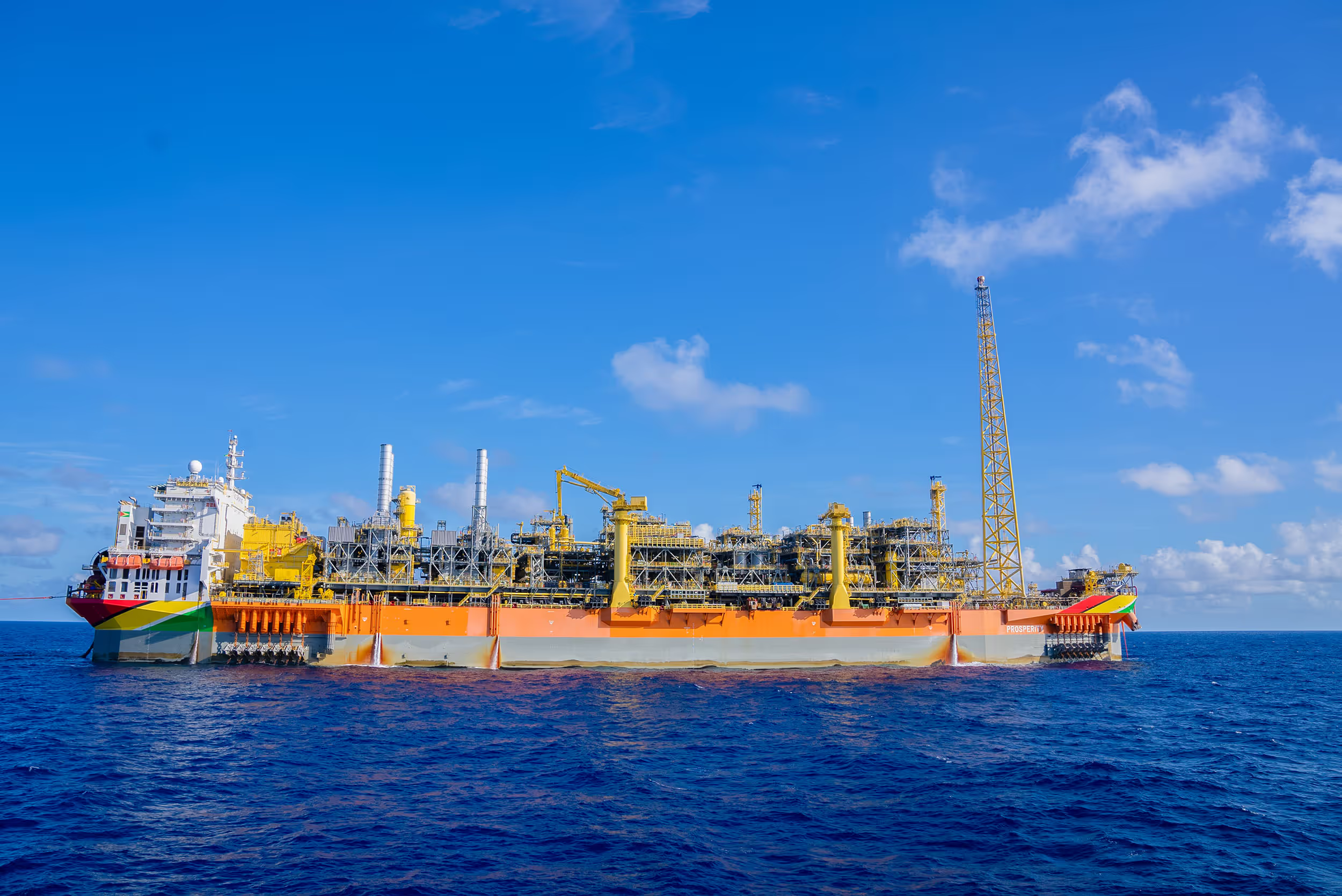
















ExxonMobil has reached a major financial milestone in Guyana earlier than expected, fully recovering more than US$55 billion invested in exploration, development and operating costs across the Stabroek Block.
The achievement, announced during the company's second-quarter earnings call on Friday, marks a turning point not only for Exxon and its partners, but also for Guyana, as a greater share of future revenues will now flow directly as free cash flow rather than toward recovering past investments.
Exxon executives attributed the accelerated recovery to faster-than-planned project execution, lower development costs, exceptional operational performance and stronger oil prices.
"We fully recover the US$55 billion of investment along with all the operating costs," Neil Hansen Senior Vice President and Chief FinancialOfficer
said.
Why the recovery happened early
Under Guyana's Production Sharing Agreement (PSA), the ExxonMobil-led consortium is allowed to recover eligible exploration, development and operating costs using up to 75% of monthly oil production, commonly referred to as "cost oil."
Once those costs are recovered, the remaining production, known as "profit oil", is shared equally between the Government of Guyana and the contractors, after the payment of the 2% royalty.
When the Stabroek discoveries were first developed, Exxon expected investment recovery to occur later in the decade. Instead, several factors accelerated the timeline.
Chairman and Chief Executive Officer Darren Woods said the company delivered production vessels faster than originally anticipated and at lower cost while consistently exceeding expected production levels.
"The production units [were delivered] faster than we had originally anticipated, at a lower cost, running those assets above the investment basis, and then obviously the market prices have been higher than our base assumption," Woods said.
"All that means more cash sooner."
Hansen added that even excluding the benefit of higher oil prices, investment recovery was accelerated by approximately two years because of execution and operational performance alone.
He cited FPSOs operating at more than 98% reliability, production averaging roughly 100,000 barrels per day above the original investment basis, and industry-leading project delivery.
What changes now?
Although Exxon has now recovered the US$55billion already invested, that does not mean cost recovery ends.
Hansen explained that new capital spending and operating costs from future developments, including new FPSOs and field expansions, will continue to enter the project's "cost bank" and remain eligible for recovery under the PSA.
However, because the historic investmen thas now been recovered and production has grown significantly, the cost bank is unlikely to return to previous levels.
"The reality is, we have more investment," Hansen said.
"To the extent we have the investment come in and operating costs, it'll still go into the cost bank... but there's much less investment to recover."
That means a larger portion of future revenues will become free cash flow instead of being used to repay past investments.
"We would anticipate... now that we've reached full recovery of that significant investment, more of our revenues will go towards free cash flow versus recovering cost and investment."
Asked whether investors should view this as an inflection point in Guyana's cash generation, Hansen answered unequivocally.
"It's a very reasonable way to frame it."
"It's very much an inflection into free cash flow."
While Exxon's entitled production volumes may decline modestly as the PSA evolves after cost recovery, Hansen stressed that value, not volume, is what matters.
"For us, this is about value. It's not about volume," he said.
"Even though there's a slight decline in the entitled volume, the focus we have is on the value that we've created for ourselves and for the Government of Guyana."



.png)
.jpg.jpeg)