

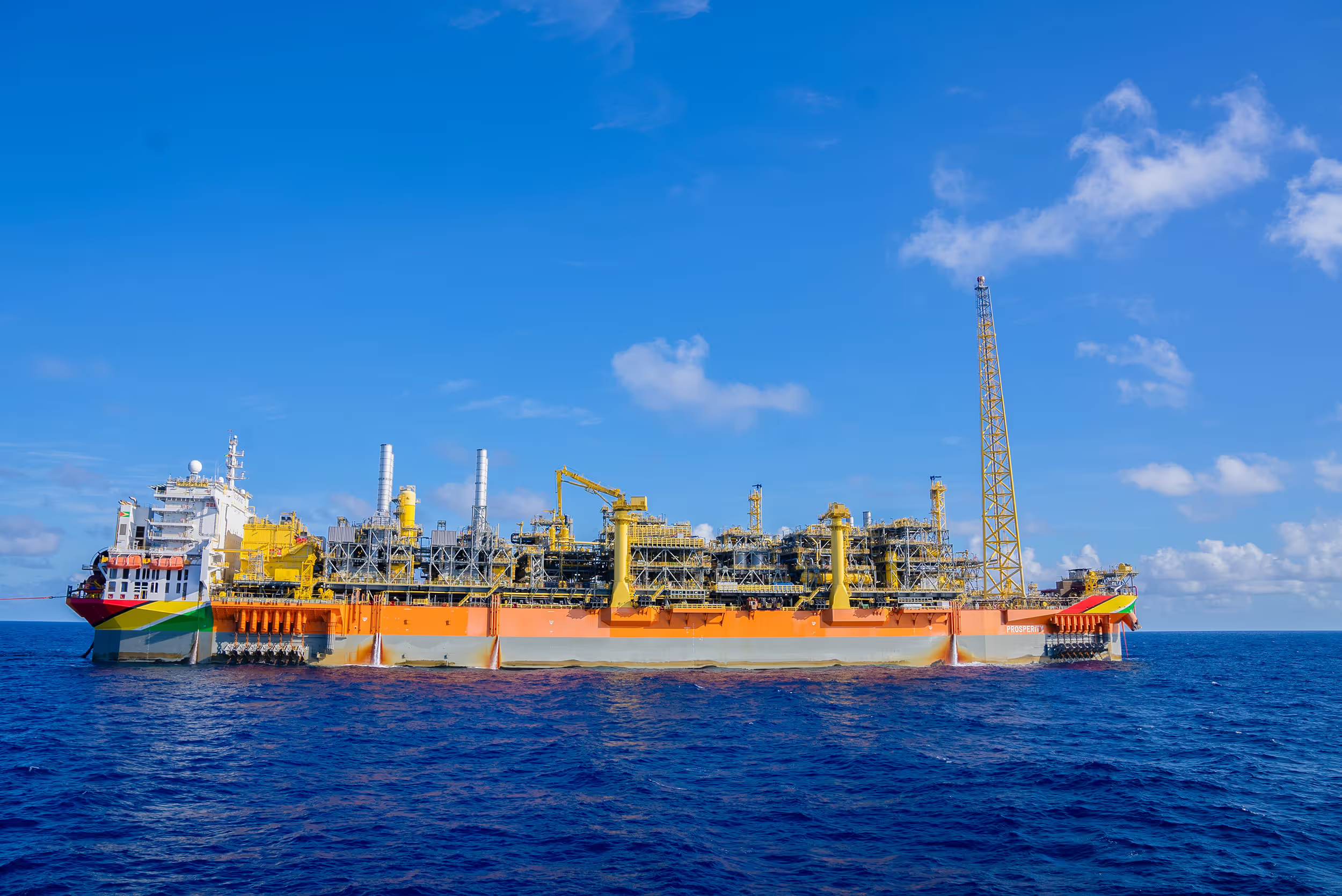













ExxonMobil will get fewer barrels from Guyana later this year but not because production is falling. It's because more of the oil currently produced offshore in the Stabroek Block is entering the profit-sharing stage with Guyana.
When ExxonMobil says it expects to get about 100,000 fewer barrels of oil per day from Guyana in the third quarter, that does not mean less oil offshore Guyana. In fact, Guyana's offshore production remains strong.
What is changing is how the oil is divided between the ExxonMobil-led consortium involved in oil production, and Guyana.
That is an important distinction because Exxon's latest earnings report uses a term called "net entitlement", essentially, the amount of oil Exxon can count as its own after the terms of Guyana's oil deal are applied.
So, fewer barrels for Exxon does not automatically mean fewer barrels being produced offshore.
Think of it this way: imagine Guyana's oil production as one large pot.
The oil companies don't simply take half of that pot from the beginning. First, Guyana receives its 2 per cent royalty — a sum the country gets upfront before any costs are recovered or any profits shared.
Then, under the Production Sharing Agreement, the oil companies can recover certain approved costs from a portion of the production. This is the cost-recovery stage. Under the agreement, up to 75 per cent of production in a month can be used for cost recovery.
But as more of those costs are recovered, as they have been, the calculation changes. And that's where Guyana's share becomes increasingly important.
Once royalty and recoverable costs have been accounted for, the remaining oil is known as profit oil.
That profit oil is then split 50/50 between the Government of Guyana and the oil consortium (which is further divided: ExxonMobil - 45%, Hess - 30% and CNOOC - 25%).
So as projects move further beyond the heavy cost-recovery period, more of the production can move into the profit-oil pool.
That means Guyana receives a larger share of the overall production, while Exxon's (and the other oil companies’) entitlement can fall, even though the oil is still being produced offshore.
Exxon says it has recovered its Guyana investment about two years earlier than expected, helped by strong production and project performance. That means the Stabroek Block moved faster toward the stage where more of the oil is treated as profit oil and Guyana gets its 50 per cent share after the 2 per cent royalty and eligible cost recovery.
And the important point is that this shift is happening while production is still climbing, not falling. Guyana is producing around 900,000 barrels a day today, and with additional FPSOs coming on stream, production is expected to rise to roughly 1.4 million barrels a day by 2027.
That's what makes Exxon's latest figure easy to misunderstand
Exxon said in its second-quarter earnings presentation that its “Guyana net entitlement” is expected to decrease by approximately 100,000 barrels per day in the third quarter. That is Exxon's share. It is not a forecast that Guyana's offshore production will fall by 100,000 barrels per day.



.png)
.jpg.jpeg)